Showing posts with label gaming aid. Show all posts

2024-02-17

Random City-Centred Sandbox: Example of Use

Let me show you an eample of how my random city-centred sandbox can be used.

First, I assume the city has been generated and named according to the instructions.

Second, I roll 2D8 to place the waterway. I roll 3 and 7. There is a river flowing though the side, and I replace the road segment in square No.7 with a river segment.

Third, let us assume the adventurers leave the city by the southern gate. I roll 1D4 to populate square No.7, rolling a 2: there is a road that intersects the river.

The adventurers take the road eastwards. I roll 1D4 to populate square No.8, rolling a 3: there are orchards.

The adventurers continue eastwards. I roll 1D4+1 to populate te following square, rolling a 4: 4+1=5— I must roll on Table B. I roll 1D6, rolling a 5: there is a cavern.

You get the idea 🙂

sample map


City-Centred East Asian Sandbox

Imperial Chinese cities would almost invariably be square and walled, with a street grid orientated according to North-South and East-West axes. There would be a main gate at the middle of each wall segment, with a large road leading to it.

The city itself would be quite isolated, the centre of imperial law and order amidst a vast, unruly wilderness.


starting city map

In this blog post, I will present a method to generate a sandbox centred on an imperial Chinese city.

First, generate your city per my blog post from 13 April 2012. Name the city per this other blog post. This will be the adventurer party’s base.

Second, roll 2D8 to determine the direction of the closest waterway; trace it on the map above by joining the two numbered squares. If the two rolled numbers are identical, replace the waterway with a lake.

Third, populate the map as your adventurers start exploring the region around the city. As indicated above, roll the die on Table A depending on the background colour of the square being explored:

Dark green: roll 1D4 on Table A.

Medium green: roll 1D4+1 on Table A.

Light green: roll 1D4+2 on Table A.

Yellow: roll 1D8+4 on Table A.

Table A - Master Table
Die Results
1 Fields
2 Road†
3 Orchards
4 Farms
5 Re-Roll, Table B
6 Grassland
7 Forest
8 Hill
9 Wasteland
10 Swamp/Marsh
11 Sea/Lake
12 Mountain/Peak

†If there is already a road, add one that is perpendicular to the already-existing one.

Table B - Uncommon Locations
Die Results
1 Tower/Pagoda
2 Hamlet
3 Village
4 Shrine/Temple/Monastery, Orthodox
5 Cavern/Grotto
6 Re-Roll, Table C

Table C - Special Locations
Die Results
1 Hermit/Isolated Scholar
2 Bandit Lair
3 Martial Arts School/Secret Society Headquarters
4 Shrine/Temple/Monastery, Heterodox
5 Re-Roll 1D4 on Table C, Abandoned
6 GM's Choice

A final note: This method is different from my post here where the idea was for the GM to prepare a whole region ahead of running their game. Here the idea is to randomly make up the region as the game unfolds, so as to surprise both the players and the GM.

2015-11-09

Random Prefecture Generator

Judge and Retainers
Whenever I have been GM'ing using The Celestial Empire or Oriental Monsters & Magic, I have found that character parties built around a judge accompanied by retainers, bodyguards, etc. have worked really well in a Chinese context.

In a highly civilised society such as China, with little personal freedom, little motivation to transgress the boundaries of what one is restricted to, and especially in a society that frowns upon the use of violence, the only possibility for the kind of anti-social behaviour that RPGers enjoy is law enforcement.

Well, a judge in China was assigned a city where he would work as a magistrate, carrying out sentences and settling disputes, but also collecting tax, repairing broken bridges, repressing banditry, and suppressing unorthodox cults.

So the first thing to draw up for your judge PC and his fellow PCs is the prefectural seat he's going to spend the next three years in! For that purpose, I have developed a hack of Éric Nieudan's own more generic classic fantasy random wilderness generator.

What you need:
 - A standard 52-card deck with French suits (♠♥♦♣); remove the jokers and the 2's.
 - Dice.

1. Draw cards to make a 7×7 grid; leave centre of grid empty. The centre is your city:


2. Terrain the remaining 48 areas according to card suit; face cards mean there is a steading. See tables below:

 Terrain 
  plains or steppe
 ♣ woods or swamp 
  hills or desert
 ♠ mountains or canyons 

 Steadings 
 Jack: village, hamlet or camp 
 Queen: temple, shrine, other holy place 
 King: manor or mansion
 Ace: town or harbour

Choose or draw another card for subtypes, e.g.:

 Second Card Drawn   Village Sub-Type   Temple Sub-Type   Manor Sub-Type 
   Hàn Chinese  Confucian  Retired Mandarin 
 ♣  Hàn Chinese  Buddhist  Guildhouse
   Hàn Chinese  Daoist  Head of Local Lineage 
 ♠  Ethnic Minority   Folk Religion  Wealthy Landowner 

 Third Card Drawn   Buddhist Sub-Type   Daoist Sub-Type 
   Pure Land  Complete Orthodoxy (Zhèngyi) 
 ♣  Chán  Quánzhēn
   Tantric  Xié
 ♠  other  other

3. Encounters and events. Now, whenever the judge and his companions are travelling throughout the prefecture, random encounters may happen! For each card, roll d20 and compare to card value (Jack = 11, Queen = 12,  King = 13, Ace = 14). If the die roll is ≤ card value, look at the encounter on the table below.

Variant: Use a d10 in the light grey area.

 Die   Civilised Encounters
Die roll < card value 
 Events
Die roll = card value 
 1   Farmers travelling ♣foraging poaching ♠fleeing 
 2   Fishermen working ♣mending nets famished ♠building a dam 
 3   Merchants caravan ♣lost being robbed ♠loaded with silver  Ambush or trap 
 4   Monks preaching ♣looking for help begging ♠on a pilgrimage   Impromptu market 
 5   Soldiers labourers ♣conscripts militia ♠press-gang   Freak weather 
 6   Ethnic minority mercenaries ♣traders confidence artists ♠clan   Blocked roads 
 7   Nomads Steppe ♣Forest Desert ♠Mountain  Fire 
 8   Adventurers bruised & beaten ♣hostile friendly ♠richly equipped   Flood 
 9   Indigenous people warband ♣migrating raiding ♠hiding  Battle 
 10   Koreans merchants ♣ambassadors prisoners ♠seamen   Ghosts 
 11   Bandits river raiders ♣on the run hiding ♠carrying plunder   Country fair 
 12   Thieves street thugs ♣running from the law spies ♠burglars   Bandit Lair 
 13   Vietnamese merchants ♣ambassadors prisoners ♠pilgrims   Siege 
 14   Plague 

Feedback and suggestions welcome.

2014-07-02

A Fantastic Film And A New Sect

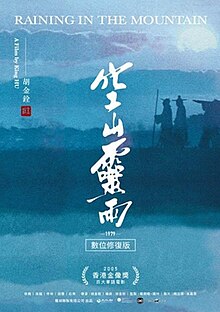
I needed a mental break from work the day before yesterday and so I watched one of my all-time favourite films, Raining In The Mountain (空山靈雨, 1979) by King Hu (Hú Jīnquán 胡金銓).

The film reminds me of those "behind closed doors" films, in which the action is restricted to a single room or locale — except that in this case the 'single locale' is a huuuuge maze-like monastery set in a remote mountainous area. The film was actually shot on location in South Korea. I wish I knew the name of the actual monastery because it is absolutely amazing.

The film is set in the Míng. The Three Treasures monastery keeps the only extant copy of a handwritten scroll penned by the famous Táng dynasty monk Xuánzàng, and two opposing parties of "adventurers" both try to steal the coveted treasure whilst the monks are themselves embroiled in a bitter succession struggle... I'd love to run this as a 2-GM, 2-party adventure, pitting each party against the other and both, simultaneously, against the monks who guard the treasure!

Anyway,  one of the minor protagonists of the story is the powerful lay master of a fictional Buddhist sect called the Vimalakīrti School*. He is fully dressed in Esoteric accoutrements and is constantly accompanied by a score female martial artists who act as his bodyguards. That's quite a cool NPC.

So here's the VIMALAKĪRTI SCHOOL for The Celestial Empire:

Period of Time
Míng

DESCRIPTION
Under the Míng, the state religion is Neo-Confucianism. The religious life of Buddhists turns increasingly towards isolated monasteries. It is hence difficult for lay practitioners interested in Buddhism, especially anybody with official duties, to be seen in the company of Buddhist priests or monks. As a result, Buddhist schools for laypeople start appearing. The Vimalakīrti School, named after the highly influential Indian lay practitioner Vimalakīrti, is one such school — albeit a fictional one.

MEMBERS
The Vimalakīrti School appeals to well-to-do, and usually aged, lay practitioners of Buddhism: mandarins, wealthy merchants, high-level officers. It also attracts nubile young women, recruited to serve as bodyguards for the most high-ranking members of the sect.

REQUISITES
Male Members
Allied with Buddhism or with Esoteric Buddhism. Allegiance score at least 60.
Age must be at least 45.
Status must be at least 55%
Wealth must be at least Affluent.
Female Members
Allied with Buddhism or with Esoteric Buddhism. Allegiance score at least 40.
Age must be 21 at the most.
Climb at 40% at least.
Sleeve Combat at 50% at least.
Stealth at 35% at least.

BENEFITS
Male Members
Male members enjoy the usual benefits of a high profile secret society (connections, relationships, e.g. a network of guānxi). They will always find a place to stay (or to hide!) in the monasteries that sponsor the sect, even if they call unannounced.
Female Members
Female members are taught all the powers pertaining to the Mìzǒngquán Martial Arts school.

OBLIGATIONS
Male members
Male members must always help the monasteries that are part of the sect's network, to the point of ignoring official requests, e.g., a mandarin receives an order to cancel the tax exemption from which a monastery has benefited: he will do his utmost not to enforce the order.
Female members
Female members are required to act as bodyguards for the most high-ranking male members of the sect.

*from the Wikipedia: “the Vimalakīrti Sūtra became one of the favourites in East Asian Buddhism. However, the sūtra was not used as an object of devotion, and no school was ever formed around it”

2014-03-26

D100 Dread Family Secrets

Elfmaids & Octopi (EMO) is one of my favourite blogs. Its author posts very often, almost daily, and each and every post is oozing with re-usable ideas, usually on the gonzo side. As a result, I usually steal from EMO for my science fantasy or Second Age Gloranthan games, but certainly not for my historically accurate East Asian games.

Yet the latest EMO blog entry, titled D100 Dread Family Secrets, can probably be enjoyed in a semi-historical Chinese game, what with the importance of kin and ancestor worship.

I am presenting a slightly revised version of the table below that takes into account the East Asian background of The Celestial Empire:

Prominent clans/NPCs/PCs of your campaign game may warrant a 1D100 roll once (or even twice!) on the following table to determine a dread family secret:

D100 | Dread Family Secret
01 | Parents are siblings, family history of incest, your own sibling loves you
02 | Bànyāo ancestor in family (see p112 of The Celestial Empire)
03 | Necromancer ancestor after descendants bodies to be reborn
04 | Hǎiruò in distant ancestry
05 | Family member is a famous wanted outlaw in secret
06 | A Xié Daoist in family (see p98 of TCE)
07 | Secret society in family (see p102 of TCE)
08 | A serial killer in the family
09 | Generations of inter sibling violence
10 | Ancestral ghost nags descendants to perform horrible acts
11 | Ancestral ghost nags descendants to avenge some forgotten crime
12 | Ancestral ghost nags descendants for libations of wine
13 | Ancestral ghost nags descendants to marry into better bloodline
14 | Ancestral ghost nags descendants to sacrifice silver ingots to family burial plot
15 | Ancestral ghost nags descendants to follow their favourite cult
16 | Dread mìngmó is ancestor (see p117 of TCE)
17 | Famous yaksha is ancestor (see p126 of TCE)
18 | Ancient vixen spirit is ancestor (see p112 of TCE)
19 | Ancestor served a god who meddles in family affairs
20 | Cannibalism practised by some members till recently
21 | Ancestors stole a relic or artefact which they keep hidden
22 | Ancestral blood feud with other clan over land
23 | Ancestral blood feud with other clan over over runaway missing lovers
24 | Ancestral blood feud with other clan over missing legendary weapon
25 | Ancestral blood feud with other clan over over battlefield betrayal during inter-dynastic period
26 | Ancestral blood feud with other clan over murder of prominent ancestor
27 | Ancestor famously declined office in the imperial bureaucracy
28 | Ancestor famously refused summons to imperial court
29 | Rumoured to have immortal ancestry
30 | Rumoured to have guǐ-creatures in ancestry
31 | Rumoured to have yāoguài in family
32 | Family keeps many mad members of clan locked in family home
33 | Family home has many hidden corpses and rumours of phantoms in estate
34 | Ancestor made pact with foreign cult to maintain the clan
35 | Family really broke on edge of complete ruin
36 | Family famous misers
37 | Ancestor served foreign ruler as right hand man
38 | Famous ancestor late with message triggered disaster
39 | Famous traitor ancestor joined nomads in war at crucial moment
40 | Ancestor famous sexual pervert people tell stories of to scare children
41 | Cruel ancestor ruled a village terrorising locals for a generation
42 | Ancestor was cursed by gods for blasphemy, curse still carried by clan head
43 | Ancestor murdered children to attain control of clan
44 | Ancestor was a famous poisoner
45 | Ancestor disappeared in cave with important official documents
46 | Ancestor famous amateur torturer, victims bodies still found in family home
47 | Cats hate family and go crazy when near
48 | Dogs hate family and go crazy when near
49 | Horses hate family and go crazy when near
50 | Birds hate family and go crazy when near
51 | Family exterminated another family to get land
52 | Family usurped title and land of original owners
53 | Ancestor a notorious grave robber
54 | Ancestor a Xié Daoist who was sentenced to death after public trial
55 | Ancestors were low-status Ritual Masters
56 | Ancestor Xié Daoist was hunted and killed by mob, swore vengeance on whole village
57 | Ancestor a famous thief of long lost goods owners still want
58 | Ancestor lived in now haunted temple or manor that locals have sealed up and shunned
59 | Ancestor famous slanderer whose malicious lies about other clans still believed today
60 | Family home built on a non-Hàn burial ground or temple site
61 | Many believe under family home are catacombs with horrible secrets
62 | Ancestor linked to foreign cult, strange pilgrims always visiting
63 | Ancestor a famous slaver who killed hundreds cruelly
64 | Ancestor a famous drug fiend who ruined other clans with vice
65 | Ancestor a famous rake and seducer, hated by many other clans
66 | Ancestor a famous popular harlot who was murdered by persons unknown
67 | Ancestor rumoured to have had otherworldly evil lover
68 | Clan famed for being thieving lying money grabbers
69 | Family stalked by unknown murderers for generations
70 | Family mentioned in evil prophecy so changed name in past
71 | Family full of rakes and harlots, full of bastard children
72 | Everyone thinks family has hidden treasure from looting in troubled times
73 | A doomed immortal of clan assumes identity of descendants for legal reasons
74 | Family has taint of wǎngliǎng blood (p115 of TCE), famous brutes
75 | Ancestor famously went into forest for secret rites with yāoguài
76 | A famous clumsy idiot of clan caused a huge disaster people still not over
77 | Ancestor begotten by a huòmó (p118 of TCE)
78 | Ancestor notoriously partied with (Roll 1D6) 1: foreign cultists, 2-4: outlaws, 5-6: nomads
79 | A famous spouse murderer had 3D4+3 partners before killed by enemies
80 | A famous ancestor slandered the emperor who had most of the clan killed
81 | A famous ancestor collected heterodox books and ancestors then disappeared
82 | A famous cruel ship captain was marooned by crew somewhere
83 | A famous martial artist kidnapped and killed local maidens
84 | Ancestor was rumoured to have been to the Ten Courts of Hell and back somehow
85 | Family have a horrible evil motto most think disgraceful today
86 | Famous ancestor last seen riding into hole in hill with demons, a stone slab in place today
87 | Ancestor had an affair with an imperial concubine and was horribly murdered by rivals and enemies
88 | Ancestor started a cult which was outlawed by the local magistrate after their death
89 | At a certain night ghosts appear at clan temple to condemn all for villainy
90 | Ancestor rumoured to have illicit sex with animals, family maintain just enemy slander
91 | Ancestor built a strange folly which locals avoid and fear
92 | Ancestor was of non-Hàn ethnicity so changed name in past
93 | Ancestor collected funds for temple then drunk and gambled and whored funds away
94 | Started a doomed ethnic war that resulted in thousands dead and bitter inter-ethnic resentment
95 | Briefly an ancestor held top position in imperial bureaucracy before being murdered by staff
96 | Briefly an ancestor held top position in imperial bureaucracy before being murdered by rivals
97 | Ancestor rumoured to have been evil wizard, torn apart by invisible demons in market square
98 | Ancestor rumoured to have been demon cultist or offspring, killed by animals in village
99 | Ancestor famous magician, crackpots harass clan for magic hidden secrets
00 | Ancestor famous martial artist, crackpots harass clan for hidden martial arts treatise


2014-02-23

Weather Dice

In my olden days, I used to like long, complicated tables (like these) for weather generation. Now I am more in favour of quick-and-easy methods for pretty much everything when I'm GMing, including weather generation.

I had bought a 'weather die' such as the one depicted on the left to generate weather when GMing, but it soon turned out that it was yielding results that were (a) too simple, and (b) often inappropriate for a given season.

So what I did, I bought a second 'weather die'. And I believe the combination of the two 'weather dice' is now giving satisfactory results.

If you do not have such a pair of dice (they're about £1 each in most shops), you can use 2D6 but it is going to be less fun. Let us describe the faces, and let us number them 1 to 6, for those who do not have the weather dice.

1= Overcast.
2= Snowstorm.
3= Thunderstorm.
4= Rainstorm.
5= Partly Cloudy.

6= Fair.

The illustration above shows the Raining (4), Partly Cloudy (5), and Fair (6) faces of the 'weather die'.

Use Of The Weather Dice to Determine Weather
Now, depending on the season you will use 1 or 2 weather dice.

Spring
Use 1 weather die only. Read the results as rolled, except Snowstorm (2) is replaced with Monsoon.

Summer
Use 2 weather dice and choose the "nicer" result, e.g., if you roll Partly Cloudy (5) and Fair (6), then choose Fair (6).
If you roll two 2's, then replace Snowstorm (2) with Hailstorm.

Autumn
Use 1 weather die only. Read the results as rolled, except Snowstorm (2) is replaced with Drizzle.

Winter
Use 2 weather dice and choose the "worse" result, e.g., if you roll Partly Cloudy (5) and Fair (6), then choose Partly Cloudy (5).

2014-01-27

D30 Bandit Table

The Chinese Empire is huge, and, alas!, the Son of Heaven cannot guarantee the safety of his subjects in each corner of this vast expanse.

This is particularly true for travellers: the various troops and militias are stationed in the yámen of the major cities of the Empire, in the garrisons at the barbarian frontiers, and wherever enemy raids are expected. This leaves out huge swaths of land, amongst which the mountains — which the Chinese strongly dislike anyway.

Mountains are where banditry is rife. Any right-minded traveller will stay on the roads of the Empire and give the mountains a wide berth. However, for various reasons, most notably when they are in a hurry and want to try out a shortcut, some travellers do cross the mountains. And, unavoidably, they also cross the path of the bandits living therein.

This is when this small table comes in handy.

D30 | Local bandits are...
01 | ...bloodthirsty maniacs. No discussion, no quarter. They will even pursue fleeing travellers.
02 | ...rapists. They will concentrate their efforts on kidnapping any young and/or good-looking female traveller to bring back to their mountain den to be used as a sex slave.
03 | ...from an ethnic minority that has been displaced by Hàn colonists. They hate the Hàn and will concentrate their attack on Hàn travellers.
04 | ...bored local ne'er-do-wells. If their opponents resist their attack, they will leave them alone.
05 | ...Rivers-and-Lakes (Jiānghú 江湖, see p9 of The Celestial Empire) types looking for a challenge. They will boast about their nickname/their preferred weapon/their fighting style, and expect their victims to fight, not necessarily to the death.
06 | ...army deserters. They are looking for clothes and food.
07 | ...a group of bandits posing as an extended family travelling together. Roll 1D6 for the leader (1: the so-called wife of the family head, 2-3: the faux family head, 4: one of the unassuming travellers, 5: the one who looks like the elder son, 6: the one who is looking after the cart).
08 | ...fellow travellers down on their luck. They have resorted to robbing because they are famished.
09 | ...travelling entertainers supplementing their meagre earnings with armed robbery. They have excellent Dexterity and acrobatics-related skills.
10 | ...assassin-retainers setting up a trap for another group of travellers. They don't want any witnesses and will hence kill the party to the last man.
11 | ...defrocked monks. They will act as #06 or #08 above, but will fall to their knees and start crying if there is a monk or a priest of the same Allegiance as theirs in the party.
12 | ...a party of knights-errant who mistakenly assume that the party are bandits!
13 | ...professional robbers. They will clearly state their name and profession, hoping to scare their victims into fleeing after having left their valuables behind, but will fiercely fight if necessary. They are of average strength (skills in the 35% range); the leader is in the 50% range.
14 | ...professional robbers. They will clearly state their name and profession, hoping to scare their victims into fleeing after having left their valuables behind, but will fiercely fight if necessary. They are of above-average strength (skills in the 50% range); the leader is in the 65% range.
15 | ...professional robbers. They will clearly state their name and profession, hoping to scare their victims into fleeing after having left their valuables behind, but will fiercely fight if necessary. They are quite strong (skills in the 65% range); the leader is in the 80% range.
16 | ...clever planners. They have been observing the party for hours through their spies in the mountain, and know most of their strengths and weaknesses. Allow bonuses as appropriate, depending on how the PCs react.
17 | ...very astute planners. They have been observing the party for days via their agents in the inns in the region, and know all of their strengths and weaknesses. Allow bonuses as appropriate, depending on how the PCs react.
18 | ...of a quasi-military kind of organisation (à la Water Margin). Unless composed of high-level PCs (skills in the 90% range), the party don't stand a chance. They will be captured by the bandits and will be held for ransom.
19 | ...the agents of an evil Daoist sorcerer, looking for special components for a heterodox ritual (e.g., "the liver of a virgin", or "the blood of a monster-hunter").
20 | ...a party of merchants down on their luck. They have been robbed themselves of their wares, and have resorted to robbing to recoup their losses. They are clumsy fighters.
21 | ...hardened outlaws, who will readily assess the situation, and understand where valuables are hidden (if any).
22 | ...scholars at odds with authority. They don't wear any armour, and don't look like fighting men, but they are actually well versed in the art of war, taking full advantage of the features of the terrain, and possessing above-average fighting skills.
23 | ...the bored offspring of the local dignitaries. They are weak fighters, and will drop their weapons and flee as soon as they realise that their opponents are way above their level. However, they will run to the local magistrate and pretend they have been attacked by the PCs; the latter will hence be in serious trouble with the local authorities.
24 | ...the bored offspring of the local dignitaries. They are capable fighters. Should any of them be killed by the PCs, the latter will be in serious trouble with the local authorities.
25 | ...vixen spirits (see p112 of TCE) with glamour-like magic. The bandit party is composed of the charmed former victims of the yāohú, ordered to act like vicious bandits. The vixen spirits, who look like damsels in distress, expect the PCs to 'save' them from the 'bandits'. Once they've been 'saved', they will take advantage of the journey to try and charm the party, and the story will repeat itself...
26 | ...bànyāo serving a mìngmó  (p112 and p117 of TCE). The mìngmó lives above a yīn ley line (see p85 of TCE), and needs the PCs for some nefarious purpose. This particular encounter is more like a mini-adventure and needs extra preparation work from the GM.
27 | ...chīmèi (p113 of TCE). They look for magic items, spell books, etc. Riches do not interest them.
28 | ...wǎngliǎng (p115 of TCE). They are fanatically anti-Buddhist, and will first and foremost target Buddhist PCs.
29 | ...yaksha  (p126 of TCE) posing as human travellers. They are looking for yet more riches to add to their treasure, hidden in a deep cave in the mountain. If the PCs look poor, they will ignore them. If the PCs look rich, the yaksha will wait for the best opportunity to steal their riches. Yaksha are not particularly hostile, and will prefer ruse to brute force. However, they are extremely greedy, and will stubbornly hang on to their plan if they PCs are indeed wealthy.
30 | ...a party of monster-hunters who mistakenly assume that the party are really monsters posing as human travellers.

2014-01-10

Random Campaign Generator

There have been a few posts in the gaming blogosphere about describing your setting in 25 words, e.g. here.

This post will provide a means to randomly fill in those 25 words. It will also double as a random Celestial Empire campaign game generator.

The setting is a [1st keyword][2nd keyword] set in [3rd keyword] dynasty [4th keyword]. The player characters are pitted against [5th keyword] set to [6th keyword]. Most of their foes are [7th keyword].

Table No.1, keyword: genre
Roll 1D6
1: Historical
2: Low-magic
3: Wǔlín
4: Wǔxiá
5: High-fantasy
6: Gonzo

Table No.2, keyword: game type
Roll 1D6
1-2: Sandbox
3-4: Series of connected adventures
5-6: Big campaign

Table No.3, keyword: dynasty
Roll 1D8
1-2: Táng
3: Sòng
4: Yuán
5-6: Míng
7-8: Qīng

Table No.4, keyword: region
Roll 1D12
1: Inner Asia
2: Gānsù
3-5: North China
6-7: Lower Yángzi
8-9: Sìchuān
10-11: South China
12: islands and seas

Table No.5, keyword: foes
Roll 1D12
1: Kinsmen
2-3: Members of the (Roll 1D6) 1-4: eunuch faction, 5-6: anti-eunuch faction
4-5: Members of the (Roll 1D6) 1-2: military, 3-4: secret police, 5-6: bureaucracy
6: Loyalists
7: Outlaws
8: Rebels
9: Members of a shètuán (TCE p100)
10: Members of an ethnic minority
11: Members of a sect
12: Merchants

Table No.6, keyword: aim
Roll 1D10
1-2: Amass power
3: Amass wealth
4-5: Further their agenda
6-7: Travel (Roll 1D6) 1-2: through China proper, 3-4: through the frontier provinces, 5-6: abroad
8-9: Fight against their opposite faction— or a GM-devised one if no opposite faction exists
10: Proselytise

Table No.7, keyword: allegiance
Use the Religion availability table appropriate to the dynasty rolled in Table No.3 above, see p48 of TCE.

More campaign game ideas are available in The Celestial Empire on p18-20 and on p40-41.

2014-01-07

D30 Local Magistrate Table

China is an immense empire. Although it is an empire, it lacks feudality: there aren't any local rulers below the emperor.
China is a centralised empire: the emperor sends out magistrates to rule the various provinces in his name. The magistrate is a lonely person who must perform day-to-day governance, mete out justice, oversee tax collection, road repairs, and churn out reports for the bureaucracy in the capital, and who changes location every three years to avoid becoming enmeshed in local politics.

These magistrates are hence quite lonely individuals. Some of them are over zealous, some others spend their time reading poetry whilst ignoring the local bumpkins. Some of them are incorruptible, some others amass bribes...

So whenever your PCs arrive in a new city, you may want to roll on this table to have quick and fast ideas for the behaviour of the local magistrate. This is especially useful if the PCs have ran afoul of the laws of the Empire.

D30 | Local magistrate is...
01 | ...a very thorough investigator. He explores all paths, interrogates all witnesses irrespective of their social class, and keeps all suspects in gaol during the investigations.
02 |  ...incorruptible.
03 | ...exaggeratedly social and friendly.
04 | ...a bookworm obsessed with antiquity. For each case, he'll try and find a similar case in the annals of the district, and try and align his verdict on the earlier one(s).
05 | ...obsessed with  the chivalric stories from the Rivers and Lakes. Should the PCs behave in a chivalrous way, the magistrate will highly respect their opinion.
06 | ...disgusted with having been assigned to this backward district. He keeps complaining about the weather/the food/the local dialect.
07 | ...a womaniser. Should the party include a female PC, the magistrate will try and sleep with her.
08 | ...gay and openly interested in the most handsome male PC.
09 | ...crazy about alchemy. His private quarters within the yámen are full of dangerous substances.
10 | ...convinced that murderers do not act by their own volition but because they are under the spell of evil spirits. In case of a murder, he will do his utmost to find an exorcist.
11 | ...only interested in complex cases and bored by straightforward ones.
12 | ...extremely wealthy and uses his wealth to further his peculiar interest or obsession (roll a second time to determine it).
13 | ...fascinated by yìqi and by the world of the Jiānghú (see p9 of The Celestial Empire). If the PCs are Rivers-and-Lakes types, he'll constantly be pestering them to hear their stories from the Rivers and Lakes.
14 | ...mostly interested in the mastery of the four pastimes. Anything else bores him. Should one of the player characters show interest in any of the four pastimes, the magistrate will become very friendly to him.
15 | ...a bigoted Buddhist.
16 | ...a good practitioner of wǔshù. Should one of the player characters be well versed in martial arts, the magistrate will try and challenge him to a fight.
17 | ...a superstitious Daoist.
18 | ...an austere Confucianist. He'll make the life of any religious PC miserable.
19 | ...a gambler.
20 | ...formerly from the Green Forest (see p9 of TCE) and lives in the terror of being exposed.
21 | ...a glutton.
22 | ...extremely distrustful of the world of the Jiānghú. If the PCs are Rivers-and-Lakes types, he'll make their life in his district miserable.
23 | ...extremely poor and always saving money on everything.
24 | ...from an ethnic minority. It's almost impossible to understand what he says.
25 | ...involved in local politics, being allied with a local clan against another local family, and always trying to take advantage of his position to hurt the interests of the latter.
26 | ...very distrustful of adventuring types. He'll try to indict the PCs.
27 |  ...an active, young judge, carrying out the investigations by himself.
28 | ...stern and aloof.
29 | ...ever expecting to collect bribes.
30 | ...eager to get rid of the case. As soon as he gets someone who seems to be the culprit, he closes the case.

2013-06-11

Fantasy Asia

OK, this is from a European perspective, so rather inconsistent with the Chinese bias I've chosen for The Celestial Empire, but it still may be fun, especially if you're leaning on a more 'high fantasy' view of frp.

The Travels of Sir John Mandeville is a 14th century European book describing the fantastical travels of one Jehan de Mandeville through a fictionalised version of South Asia and East Asia. Jehan de Mandeville's version of East Asia features the Christian kingdom of Prester John, and Tartary.

Via Phersu, I have retrieved a nice map of Asia that encompasses all the mythical places visited by Jehan de Mandeville. With little work, it could become a great high fantasy setting for East Asian adventuring.

Suggested gazetteer (using the key from the map):

 - Empire of Prester John. This is a large Christian empire practising Nestorian Christianity (see p39 of TCE). It might have a European-like social structure, in which case the GM should use a 'classic fantasy' or a European sourcebook (e.g., Crusaders of the Amber Coast), or it could have a standard Central Asian society but with a Christian touch.

 - Empire of the Grand Cham of Cathay. This is simply Yuán China as imagined by the Europeans of the time; 'Cham' is a mispronunciation of 'Khan', the title of the ruler of the Mongols. Tartary is Mongolia, Serica is North China, and Mangzhi [sic, this should actually be spelt 蠻子 Mánzi] is South China.

 - the Realm of Gog-Magog (“Here Be Monsters”). This land is separated from the civilised lands to the west by the Iron Wall, a Great Wall of China-like series of fortifications built by Alexander the Great to keep the monsters of Gog-Magog from invading the western lands. These monsters could be goblin-like, should the GM want to add elements of classic fantasy to an East Asian milieu, or they could be drawn from p123-6 of The Celestial Empire. Note that Gog-Magog is probably the inspiration behind the Shadowlands and the Carpenter Wall of the Legend of the Five Rings role-playing game, so you may also use material from that game to set adventures in the Realm of Gog-Magog.

 - Land of Perpetual Darkness (#3, Asia). This is the Forest of Darkness from various Central Asian legends. It holds many wondrous treasures but once one has entered it, it is extremely difficult to leave it. I would place it in Western Siberia (p28 of TCE) rather than in the Caucasus as on the map.

 - Griffon Mountain (#6, Asia). Er, Griffin Mountain.

 - Isle of the Unicorns (#7, Asia). It's actually inhabited by qílín, see p122 of TCE.

 - Vale Perilous (#8, Asia). This is a hidden valley in the Empire of Prester John inhabited by èmó (p116 of TCE), and ruled by mìngmó (p117 of TCE).

 - City of Birds (#9, Asia). This is actually a city of yǔrén (p123 of TCE), mistaken for birds because of their plumage.

 - The Bewitched Hills (#10, Asia). This is a rolling land so agreeable that any traveller arriving here loses any desire to leave it. In gaming terms, on the first day in the Bewitched Hills the traveller must roll his POW vs 13 on the resistance table. In case of failure, he cannot leave the country. In case of success, he may stay or leave, but the roll will be vs 14 on the second day, and so on.

 - The Terrestrial Paradise (#11, Asia). This is actually a huge caldera with a large vent in its centre that gives access to Agartha and to its capital city of Paradesa — the resemblance between the names 'Paradise' and 'Paradesa' could explain the equivocation!

 - Land of the Trees of the Sun and Moon (#12, Asia). According to Chinese mythology, the sun rises from a gigantic mulberry tree, called the Fúsāng 扶桑, in the far east. The sun then follows the leaning branch of the mulberry tree above the earth, up to the far western end of the Kūnlún Mountains, i.e., the Land of the Trees of the Sun and Moon.

 - Dog-Headed Men, Amphibious Men, Horned Men, Giant-Eared Men, etc. (various locations): These sound remarkably similar to the creatures described in the Shānhǎi Jīng (山海經).


2013-06-07

Whistling Arrows

Whistling arrows are arrows whose head is made up of a hollow wooden or iron 'turnip' through which several holes have been drilled. Whilst flying, the arrow emits a whistling sound that is used as a signal for directing armies in battle, to confound enemies, to transmit messages, to show one's position, to scare away animals, etc. Whistling arrows (also called signal arrows) are extensively used by Inner Asian and East Asian peoples, most notably the horse nomads and the Chinese.

The 'turnip' is fairly large (3cm~10cm in diameter) and may break upon impact, depending on its material.


Stats for The Celestial Empire:

Deer-horn- or Bone-made Whistling Arrow
Value: Average
Damage: 0-1 (1D2‒1)
Chance of breaking upon impact: 60%

Wooden Whistling Arrow
Value: Expensive
Damage: 1-2 (1D2)
Chance of breaking upon impact: 40%

Metal Whistling Arrow
Value: Expensive
Damage: 1-3 (1D3)
Chance of breaking upon impact: 30%

2013-05-30

Fantastic Interactive Map of China

I have serendipitously found an amazing interactive map of China that lets you superimpose a variety of indicators over a 'Google Maps' kind of map of China. The map is consistent with the boundaries of China as of the end of the 20th century (i.e., PRC + ROC) meaning that, except for some borderland areas, it covers pretty much any region that the GM may use as the setting of his or her Celestial Empire campaign game.

Just click here, remove the already-superimposed grid, and experiment with:
 - religious sites
 - minority place-names
 - mountain peaks and passes
 - historical places: Míng garrisons, Qīng courier stops and routes, Míng/Qīng postal stations, exam seats, sections of the Grand Canal, Táng prefectural & county capitals,
 - vegetation

Postal routes and courier stops in Qīng China
Edit 24/02/2016: the interactive map has moved here.

2013-05-29

the Big Swords Society (Dàdāohuì 大刀會)

Period of Time
late Qīng

Description
The Big Swords Society (a.k.a. Big Knives Society in English) is a network of traditional peasant self-defence militias, widespread in North China during the Qīng Dynasty, and noted for their reckless courage. Their members are drawn from small-holders and tenant farmers, who organise to defend villages against roaming bandits, warlords, and tax collectors. In spite of its apparent secular aims, the Big Swords Society has a religious foundation in Chinese folk religion; its Grand Masters claimed to make the members invulnerable to bullets by magic.

Much like the Elders' Society, the Big Swords Society becomes active against the foreigners' encroachment at the end of the Qīng. On 1 November 1897, members of the Big Swords Society attacked German Catholic missionaries in Shāndōng. In retaliation, the German East Asia Squadron caused mass destruction (burnt villages, etc.). This swayed the local members of the Big Swords Society even more into an anti-foreign mood, paving the way for the Boxer Uprising a few years later.

Members
As described above, wealthy peasants with a penchant for sword-fighting and vigilantism.

Requisites
- Must be sponsored by someone who is already a member of the Big Swords Society.
- Wealth level must be at least Affluent.
- A fighting skill in cold weapons of at least 65%.

Benefits
- Allegiance in Chinese folk religion +10
- New skill: Knowledge (Group: Big Swords Society) at a starting value of 25+3D6% - Can be used to find shelter, recognise fellow members, etc., but it only works in the region where the character underwent his initiation, as the various branches of the Big Swords Society are quite independent of each other.

Obligations
- Must take part in the defence of one's village

2013-05-28

the Elders' Society (Gēlǎohuì 哥老會)

Period of Time
late Qīng

Description
The Elders' Society is a loose network of mutual-support groups that draw their members from the notables of a given region. Geographically, the Elders' Society originated in Sìchuān and Dàlǐ, in reaction to the Tàipíng Rebellion (second half of the 19th century), then expended into the rest of China at the end of the 19th century. The aim of the Elders' Society groups is to maintain the traditional structure of rural society, and to fight off foreign influence, especially Manchu and Christian influence. The Elders' Society of a given area will 'protect' the local peasants by controlling the local Folk religion temples and the local village militia forces.
At the end of the Qīng, the Elders' Society engages in several uprisings across China, most notably in South China in 1870-1; in the 1890s, the Elders' Society fosters anti-Qīng and anti-foreign sentiment in the lower Yángzi region. The Gēlǎohuì organises abortive revolts in central China in 1900, 1904, and 1906.

Members
As described above, despite its focus on the protection of peasants, the Elders' Society attracts wealthy landlords and prominent members of the local élite.

Requisites
- Must be sponsored by someone who is already a member of the Elders' Society.
- The new member must qualify as a 'well-to-do person', either through his wealth, or through his profession, or through his status.
- A single Knowledge skill related with the region must be at least 60%.

Benefits
- Help from fellow members: after his initiation, the new member is considered as kin to the other members.
- Connections in society, since most members of the Elders' Society are well-connected notables
- New skill: Knowledge (Group: Elders' Society) at a starting value of 25+3D6% - Can be used to find shelter, recognise fellow members, etc., but it only works in the region where the character underwent his initiation, as the various branches of the Elders' Society are quite independent of each other.

Obligations
- Must help fellow members
- Must defer to the judgement of 'resident elders' (dāngjiā)
- Risk of death penalty if caught by government agents

2013-04-17

[A-Z April Blogging] [P] Pastimes

The cultivated Chinese gentleman-scholar is expected to master four pastimes:

1 — Calligraphy (書 shū)
2 — the Game of Go (圍棋 wéiqí)
3 — Painting (畫 huà)
4 — Playing the Lute (琴 qín)

Calligraphy
Calligraphy falls under the skill of Literacy (Classical Chinese), as explained on p59 of The Celestial Empire. One's calligraphy is thought to convey one's personality. As a result, an ugly writing is a social catastrophe. There are many different calligraphy styles, corresponding to different time periods and/or to different expectations (a regular style will convey mastery of the brush strokes, a cursive style manual dexterity). The brush, ink, paper, and ink stone are the essential implements of calligraphy. They are known together as 'the Four Treasures/Jewels/Friends of the Study'. The GM may want to add exceptional implements that give a bonus to the character's Literacy (Classical Chinese) skill.

Go
The relevant skill is Gaming. The game of go predates the Táng dynasty. In Imperial China, for some reason, the game of go is considered as a refined pastime, whereas chess (象棋 xiàngqí) is the game of the masses. See also the section titled 'Entertainment' on p17-8 of TCE.

Painting
The relevant skill is Art (Chinese Painting). Chinese painting is mostly an extension of calligraphy since its highest form, brush painting, uses a single brush and black ink only. Other styles add colour and usually concentrate on a recurring theme: birds and flowers, landscapes, the four seasons...

Playing the Lute
The relevant skill is Perform (Play: Lute). Contrary to other popular Chinese instruments, rumoured to be of Central Asian origin, the Chinese lute is felt as both a native instrument, and as the province of the literati. Countless books have been written by gentlemen-scholars on the art of playing the lute, and inability to play it correctly can bring social stigma. Like-minded performers gather in qín schools. The GM may develop these in a way similar to clan associations or secret societies.

The Four Arts of the Chinese Scholar (四藝 sìyì)


Success in any of the above skills can give a bonus to an Etiquette or a Status roll, if the target is a cultivated person, of course — a bandit isn't likely to be impressed by a beautiful piece of calligraphy.
Playing the Lute can also relax one's mind, and success in this skill can give a bonus to a Mental skill roll.

Obviously, failing any of the above yields a negative modifier equal to the expected bonus.

2013-04-10

[A-Z April Blogging] [J] Joseon Korea

NB— All Korean names below are followed by their Chinese transcription

Ancient Korea corresponds to the provinces of Inner Manchuria and Korea on the map on p28 of The Celestial Empire. However, Ancient Korea can hardly be considered as a single entity in the time period corresponding to scope of TCE. Under the Táng, Ancient Korea is divided into several warring kingdoms whose people do not even always share a common culture and a common language. This period ends with the unification of the Korean Peninsula (i.e., Korea proper) by the Goryeo/Gāolí (高麗) dynasty, whilst the northernmost part of Ancient Korea (i.e., present-day Inner Manchuria) falls to the Georan/Qìdān empire (契丹, p30-1 of TCE), forever lost to the Koreans.

The Goryeo/Gāolí dynasty, which is more or less contemporary with the Sòng, introduces a Chinese-style administrative system and Chinese customs; place-names and peoples' names are Sinicised. Hanmun/Hànwén (漢文, Classical Chinese) is the medium of choice for formal writing among members of the élite. Eonmun/Yànwén (諺文, vernacular script) is the least prestigious and the least consistent, and is the province of women. The middle classes use a mixed script consisting in Chinese phrases with Korean conjunctions linked by Eonmun/Yànwén particles [Chinese and Korean have completely different word order and grammar]. Under the Goryeo/Gāolí dynasty, Buddhism flourishes.

In 1232, Korea becomes a province of the Mongol empire, and shares the fate of Mongol-dominated Yuán China. Korean troops and ships provide the bulk of the Mongol invasion force that unsuccessfully attempts to invade Japan, in two ill-fated attempts in 1274 and again in 1281.

Under the Míng, Korea becomes independent again under the Joseon/Cháoxiān dynasty (朝鮮, 1392-1910), a long period of unification and of stability (except for the devastating Imjin/Rénchén wars with Japan, 1592-8). Even though it is a sovereign kingdom, Joseon/Cháoxiān Korea is a tributary state of Míng and then of Qīng China, always considering herself as the 'daughter' of Greater China. The Joseon/Cháoxiān period is considered the height of classical Korean culture, trade, science, literature, and technology.

Joseon police constable


I am providing a few guidelines below to play Korean characters in Joseon/Cháoxiān Korea. As a long, stable and Sinicised country, a Korean setting under the Joseon/Cháoxiān dynasty can be satisfactorily approximated with the TCE rules, as long as said guidelines are taken into account.

Status (p79 of BRP) is paramount in Joseon/Cháoxiān Korea, which is a highly stratified society, with very strictly-enforced sumptuary laws (regulating the dress of each social class):

Status — Social Class
01‒10 — Nobi/Núbì (奴婢): slave
11‒20 — Baekjeong/Báidīng (白丁) or Cheonmin/Jiànmín (賤民): "vulgar commoner"
21‒50 — Sangmin/Chángmín (常民): commoner
51‒60 — Jungin/Zhōngrén (中人): middle class
61‒100 — Yangban/Liǎngbān (兩班): nobility


Relations between men and women are also strictly controlled because of the Neo-Confucian ideals of Joseon/Cháoxiān Korea. Female characters can only join female professions. This limitation must be even more strongly enforced by the GM than in a 'standard' game of The Celestial Empire (p9-10 and p42 of TCE).

Player Character Characteristics

Please use the following:
Male characters: SIZ 2D6+6
Female characters: SIZ 2D6+5

Religion & Allegiance

Even though most Koreans are deeply Buddhist (several Joseon/Cháoxiān kings have written very beautiful Buddhist hymns), the state itself is officially and strongly Neo-Confucian. Throughout the history of Joseon/Cháoxiān Korea, Neo-Confucianism is always strongly enforced as the only state religion, and Buddhism is often suppressed. As a result, Buddhist monks reside in large monasteries far from city life to avoid involvement in politics, and to avoid harassment by the authorities. Buddhist priests are rare. Daoism is restricted to the odd hermit or alchemist.
Korean folk religion is similar to Chinese folk religion mixed with Shamanism, which is still strong in Korea, especially in the countryside. Monotheistic religions are absent until the introduction of Catholicism at the end of the 18th century.

Religion Availability Table (replaces the one on p48 of TCE)
Buddhism (common)
Confucianism (common)
Korean folk religion (common)
Daoism (uncommon)
Christianity [post-1786] (very uncommon)
Esoteric Buddhism/Tantric Buddhism (very uncommon)

List of Professions
Male characters
Assassin-retainer – identical to TCE
Buddhist Monk – identical to TCE
Constable – identical to TCE
Fortune-teller – identical to TCE, except Status: 20%
Geomancer – identical to TCE, except Status: 20%
Gukseon/Guóxiān (國仙) – a kind of mountain ascetic; use the 'Esoteric Buddhist Monk' template from TCE, except Allegiance: Korean folk religion 20 points; replace Knowledge (Religion: Esoteric Buddhism) with Knowledge (Religion: Korean folk religion); replace Perform (Sing) with Perform (Dance); replace Language (Manchu/Mongolian) with Language (Chinese); restrict magic to Battle Magic only, add the spells Dark and Farsee.
Hwarang/Huāláng – see the relevant post.
Magistrate – identical to TCE, except Status: 65%
Merchant – identical to TCE
Outlaw – identical to TCE
Scholar – identical to TCE, except Status: 60%
Slave – use the 'Slave' profession from p20 of Dragon Lines
Soldier – identical to TCE
Yangban/Liǎngbān (兩班) – use the 'Noble' profession from p18 of Dragon Lines

Female characters
Assassin-retainer – identical to TCE
Damo/Chámǔ (茶母) – Damo are female servants working for the police: only they can enter women-only residential areas for investigation and interrogation. These are strong, intelligent, and arms-trained women. In the history of Joseon/Cháoxiān Korea police investigations, it has been demonstrated that Damo often played major roles. In spite of this, they were ill-treated by their male counterparts. Use the 'Constable' template from TCE, except Wealth: Poor, and Status: 10%.
Gisaeng/Jìshēng (妓生) – Gisaeng are female entertainers very similar in role and accoutrement to Japanese Geisha. Use the 'Entertainer' profession from p15 of Dragon Lines; add Perform (Play: Instrument) and Perform (Sing) to the list of Primary skills. Status: 15%
Outlaw – identical to TCE
Shamaness – identical to TCE, except Allegiance: Korean folk religion 20 points, Status: 20%
Yangban/Liǎngbān (兩班) – use the 'Noble' profession from p18 of Dragon Lines

Skills

Etiquette – Base chance: 20%. Etiquette is paramount in Neo-Confucian Joseon/Cháoxiān Korea.
Firearm – Base chance: 20%. No Status skill penalty for using a firearm (they are slightly more common than in China).
Knowledge (Religion) – Base chance: 10% for common religions, 5% for uncommon religions, 0% for any other religion.
Language (Chinese) – All Yangban characters speak Chinese with a Base chance equal to EDU×3.

2013-04-08

[A-Z April Blogging] [H] Huāláng

Historically, the Huāláng (花郎, "Flowery Gentlemen") were a society of young and beautiful aristocrats from the Korean kingdom of Silla (Xīnluó 新羅), contemporary of Táng China. This is the only hard fact that can be historically confirmed, given the paucity of the sources. Little writing has survived from Silla Korea; anything else is pure speculation.

Later on, the term Huāláng came to mean: in the 13th century, 'travelling entertainer'; in the 16th century: 'male prostitute'; in the 19th century: 'boy dancer'. In the 20th century, a Korean martial arts known as Huālángdào developed, mostly in reaction to foreign martial arts. As a result, a whole Huāláng mythology was 'retro-developed' to be used as a historical basis and justification for the latter-day Huāláng (practitioners of Huālángdào). Little of this 20th-century Huāláng-mythmaking has any historical evidence whatsoever. However, gaming being gaming, we'll try and incorporate much of this more recent Huāláng mythology into The Celestial Empire.

The Huāláng started as a military band in the Silla era. The Huāláng were chosen from the young sons of the nobility; they entered a kind of chivalric corps whose aim was to uphold the ideals of complete loyalty to the nation, righteousness, and bravery: the five huāláng commandments were: serve the king with loyalty, serve parents with piety, be faithful to friends, never retreat in battle, preserve life when possible. The Huāláng were dressed up in black jackets and red skirts. Besides their martial training, they were trained to attack and drive out disease demons through exorcism. [Note: this latter skill may actually stem from a linguistic confusion between the terms huāláng‒ flower knight and huāláng‒ husband of a female shaman, so we'll ignore it in the description of the Huāláng profession below. Should the GM allow this ability, the Necromancy skill should be added to the roster of primary or secondary skills of the Huāláng profession]. The Huāláng carry wooden sticks representing swords. They are supposed to have a power to heal. They have a taboo concerning water.

From a religious point of view, the Huāláng were taught a strange mix of orthodox Confucianism and Esoteric Buddhism. This makes them all the more similar to the Japanese Ninja (the unavowed model of 20th century Huāláng), whose religious tenets were also based on Esoteric Buddhism.

Despite their Confucian upbringing, the Huāláng are mostly homosexual. This is not surprising;  many groups of closely-knit warriors in the past were homosexual.

The Huāláng: a new profession for Korean PCs only
Wealth: Affluent
Status: 60%
Allegiance: Confucianism 5 points, Esoteric Buddhism 15 points
Primary skills: Climb, Etiquette, Melee Weapon (any), Missile Weapon (any), Perform (Dance), Ride (Horse)
Secondary Skills: Command, Dodge, Grapple, Hide, Jump, Knowledge (Religion: Esoteric Buddhism), Martial Arts, Melee Weapon (Quarterstaff), Persuade, Spot, Stealth
Suggested Power: Battle Magic ‒ suggested spell: Heal; Buddhist Magic ‒ suggested spells: Diamond Dagger, Sword of Wisdom.
Equipment: A set of weapons corresponding to the character's combat skills. Expensive clothes. Horse. Roll-up ladder.
Miscellaneous:
 - To qualify as a Huāláng, the player character must be a member of the Korean nobility
 - SIZ is to be rolled using 2D6+6

2013-04-06

[April A-Z Blogging] [F] the Fǎxiàngzōng school

The following is in addition to the Buddhist sects presented in p90-4 of The Celestial Empire.

Period of time
Táng

Description
The Fǎxiàngzōng school (法相宗) is a minor Buddhist sect established by Xuánzàng (602-664), the great Táng Chinese monk, scholar, and traveller, and by his disciple Kuījī (632-682). The sect is also known as the Wéishízōng school (唯識宗). The sect is, like the Huáyán School (p93 of TCE), very much scholarly-oriented, but remains less famous than its rival. The Fǎxiàngzōng school does not survive the anti-Buddhist persecutions in the 9th century.

Members
Monks only, especially those interested in original Indian Mahāyāna texts, and in particular those of the Yogācāra tradition. Gaming-wise, it should be restricted to NPCs.

Requisites
- Knowledge (Religion: Buddhism) at 75% at least.
- Language (Sanskrit) at 50% at least.
- Literacy (South Asian alphabets) at 50% at least.
- Persuade at 50% at least.
- Willingness to travel.

Benefits
Members of this school have access to a variety of Indian manuscripts, whose perusal gives a 25% of adding +1D6% to the Knowledge (Religion: Buddhism) skill once per month of scholarly activities, e.g., translating Indian texts to Chinese.
Members of this school have access to sympathetic Buddhist organisations for food and shelter in Bactria, Sogdiana, Dzungaria, the Tarim Basin, Inner Manchuria, Korea, and Japan.

Obligations
Members of this school are dedicated to the spread of original Mahāyāna thought to East Asia, and are hence often found travelling west to India through Inner Asia (to gather new Indian texts), or east to Korea and Japan (to spread the Yogācāra tradition).
Members with a good knowledge of Sanskrit and Chinese (both above 90%) must devote at least 10% of their time translating Indian texts to Chinese.

2013-04-05

[April A-Z Blogging] [E] the Éméi Sect

As written on p103 of The Celestial Empire, fictional organisations are a staple of Chinese myth and legend. The monks of Shàolín, for instance, may have an origin in real history, but the way they've evolved in the national Chinese psyche makes them closer to superheroes than to historical figures.

Something similar has happened with the Éméi Sect (Éméi Pài 峨嵋派). Wikipedia describes it as a fictional martial arts sect from Jīn Yōng's works, whereas the web-site of the Confucius Institute describes it as a real-world sect. Given the fanciful material in the article from the latter source, I am more inclined to side with wikipedia. Anyway, this is not too important in a role-playing setting; if it's fun, it must be included.

The Éméi Sect is briefly mentioned in Crouching Tiger, Hidden Dragon: when Zhāng Zǐyí's character smashes the furniture in the inn whilst single-handedly defeating numerous opponents she says: "I am the Invincible Sword Goddess, armed with the Green Destiny that knows no equal! Be you Lǐ or Southern Crane, bow your head and ask for mercy! I am the dragon from the desert! Who comes from nowhere and leaves no trace! Today I fly over Éméi. Tomorrow... I topple Mount Wǔdāng!".

Éméi Pài 峨嵋派 ("the Éméi Sect")
The Éméi Pài is one of the leading righteous sects in the world of the Wǔlín (p9 of TCE). It is named after the place where it is based, Mount Éméi (p25 of TCE), one of the Four Great Mountains of Buddhism. Although it is a Buddhist sect, the Éméi Pài has been described as working hand in hand with Daoist righteous martial artists in Chinese fiction. Again in Chinese fiction, the Éméi Pài is said to enrol both male and female recruits. It can be used by the GM as a vessel to introduce female (N)PCs to the game, thus ignoring the usual restrictions listed on p10 of TCE.

Period of time: Yuán to Qīng
Allegiance: Buddhism
Style: external (yáng)
Powers: same as Éméiquán (p69 of TCE)
Other Powers taught: Buddhist Magic — Mantra of Bhaisajyaguru
Special: in case of dire emergency, members of the Éméi Pài in good standing within the sect, and with a Buddhism Allegiance score of 70 at the least, may request succour from the leaders of the Sect. This request needn't be carried out by a messenger: the person sending out the request may do so through a successful Meditation skill roll  — the request will then telepathically be received on Éméi Shān. The GM will have to judge whether the request is or is not justified. Should it be justified and in line with the activities of the sect, Mount Éméi will provide appropriate help in the form of a group of Éméi Pài martial artists who will travel from the nearest available location to the threat. This will require of course some wotk from the GM (size and location of the party, statting its members...)

2012-12-04

Random Adventure Generator

Over at my other gaming blog, I have posted about using one's bookshelves (and a few dice) as elements of a Random Adventure Generator.

Go over to my other blog and read the full entry if you are interested, but basically the idea is to randomy choose keywords within your various gaming (or non-gaming) books to fill in the blank spaces of a common pattern describing a possible frp adventure.

Depending on the diversity of the books used, the resulting sentence can be a sensible adventure hook, or a super-gonzo, multi-genre crazy scenario seed.

I have decided to use the Random Adventure Generator to generate such a scenario seed for The Celestial Empire. However, I have also decided to restrict the book base to my East Asian-themed books, so as to respect the setting of TCE.

The resulting adventure is as follows:
Charles-Édouard Hocquard asks the Player Characters to go to Hǎilóng (in Liáoníng) to retrieve a dictionary. The PCs will end up fighting against Toyotomi Hideyoshi in Shāndōng. During the course of the adventure, gold and jade will feature prominently.

The only "gonzo" element here is that French military doctor Charles-Édouard Hocquard was stationed in Indochina at the end of the 19th century, whereas Toyotomi Hideyoshi was active at the end of the 16th century...