Showing posts with label Japan. Show all posts

2025-10-01

the origin of Yakuza

Yakuza only appeared in the Edo period (1603−1868), yet they are a staple of Japanese-flavoured TTRPGs, irrespective of which era the game is set in.

I would remove yakuza from my games altogether, but it is obvious that players expect their being available as a choice for PCs. I have hence made some research as to what kind of profession or occupation could be the forebears of yakuza—so as to make them available in games set in the Sengoku era. According to most sources, tekiya, who peddled stolen or smuggled goods, and bakuto, i.e., gamblers (gambling being illegal) were the predecessors of yakuza. However, both groups are also only mentioned in the Edo period. Back to square one.

An article I have found (see below) mentions the gorotsuki, vagabond-like ne’er-do-wells who, apparently, were already mentioned in the Kamakura period (1185−1333). They also had a variety of different profiles (smugglers, entertainers, magic-users, etc.), so they are a good candidate for a ‘chivalrous bandit’ kind of occupation.

Here is the article: <link>

2020-04-30

Encyclopaedia of Historiography

The Encyclopaedia of Historiography by French academic publisher INALCO is freely available on-line (but not off-line) here.

It features many articles about East Asia of interest to referees and players of The Celestial Empire, inter alia:
  • East Asian Monetary History
  • Biographies of Buddhist Monks and Nuns
  • Sources for the History of Taoism
  • Chinese Imperial Capitals (The)
  • Codes and Legal Works in China
  • Historical and Institutional Encyclopaedias (zhengshu)
  • Travel Books (The) (China)
  • Chinese Cartography
  • Matteo Ricci’s World Map (The) (1602)
  • “Accounts of the Eastern Barbarians” in Chinese Official Dynastic Histories
  • Koryŏsa 高麗史 고려사 : the Official History of the Koryŏ Kingdom
  • Yongjae Ch’onghwa 慵齋叢話 (Yongjae Narratives)
  • Chronicle of the Voyage of Nosongdang to Japan
  • Instructions of the Keian Era (The)
  • Japanese Documents from the Edo Period relating to the Imjin War
  • Cao Bằng: Sources for the History of a Borderland in Vietnam before the 20th Century

2020-04-24

Tetsubō News

Tetsubō is one of those games that “almost happened”. Time and time again, it was on the brink of publication, and then for various reason it got cancelled. First in the 80s as a Japanese-flavoured Warhammer supplement, then putatively as a Dragon Warriors supplement, then two years ago it went back to its original scope and again almost got published as a Japanese-flavoured Zweihänder supplement (so much that it even got its cover that was circulated on Twitter; it’s the picture I am showing here), and now its authors are revealing that they may eventually publish it as a stand-alone role-playing game powered by the same engine as Paul Mason’s Outlaws of the Water Margin – which would be über cool since I really like the latter.

What can I say at the moment? Be patient as a Zen monk; wait and see!

2018-08-16

Rise of the Yōkai Koku - PDF Only Supplement

Alas, the crowdfunding campaign for Rise of the Yōkai Koku (a Sengoku Jidai-themed campaign by Alephtar Games) did not reach its target goal, meaning the supplement will only be released as a PDF rather than a fully-fledged book. ETA is September 2018.

2018-06-12

Rise of the Yōkai Koku - Crowdfunding Campaign Has Started

The crowdfunding campaign for Rise of the Yōkai Koku, by Alephtar Games, has started on ulule. Rise of the Yōkai Koku (妖怪國) is an adventure/campaign setting for Revolution D100 set in 16th-century Japan, at the time of the feudal anarchy known as the Sengoku Jidai (戰國時代, "Age of Warring States").
Although the campaign is specifically tailored for Revolution D100, I believe you can easily adapt it to any D100-based role-playing game.

my character from the play tests


Here are three excerpts from the ulule blurb:

"After his defeat at the hand of Oda Nobunaga, the great Daimyō Azai Nagamasa commits seppuku. The only hope for what is left of his retinue is a secret alliance with the Takeda clan, the only one strong enough to oppose Nobunaga. However, Takeda Shingen demands a hostage to guarantee the loyalty of Nagamasa’s former retainers. The hostage must reach the Shinano province without Nobunaga being aware of his presence, but the road passes through Oda territory. A group of brave adventurers must accompany the hostage in his dangerous journey."

The first part of the booklet contains two different methods to generate Japanese characters suitable to the Sengoku Jidai era – including some unusual ones – and specific rules for roleplaying in the period, and in Japanese culture in general: Buddhist schools, the influence of Shintō practices, Japanese martial disciplines and so on. The second part is the adventure itself, in which the player characters take the role of protectors of the hostage at the court of the great Takeda Shingen. The campaign is divided into ten chapters between which the players will have plenty of opportunities to evolve their characters along their preferred path.

Other information about the product:
  • Expected size 64 to 80 pages, letter format.
  • Standard character generation option based on Background and Occupation.
  • Questionnaire-based character generation option which defines your character abilities and history according to the answers you choose.
  • Stunts for Japanese swordsmanship and other martial techniques.
  • Statistics for Japanese weapons and armour.
  • Simple magic powers based on Buddhist meditation techniques.
  • Different flavours of Buddhist schools, from highly orthodox Zen to the weird practices of Shugendō, with all shades of esoteric Buddhism in between. Each school provides slightly different magic.

2018-05-12

Free Sengoku Japan Supplement for Revolution D100


As per the title of this blog post... Here is the link; in 10 pages, you get more historically-accurate RPG material than in most faux Japanese role-playing games.

Enjoy!

2017-10-12

Blank Map of Sengoku Jidai Japan

I have a found a blank map of 16th century Japan on the net and I thought I'd share it.


This can be very useful for referees GM'ing adventures set at the time of Sengoku Japan, especially should the campaign revolve around daimyō rivalry and the conquest of the various provinces (the referee can track the by progress of the various armies by using different colours).

2017-01-12

Wōkòu Mythbusting

A great article available here that busts several myths about the Wōkòu, the notorious Japanese pirates that terrorised Korean and Chinese coastal areas under the Míng.

倭寇 (Wōkòu)

Myth 1. Hǎijìn (海禁, lit. 'Sea ban') or maritime trade prohibition constituted the Wōkòu phenomenon
Myth 2. Poor Chinese coastal inhabitants were forced into piracy by oppressive Hǎijìn policy
Myth 3. Wōkòu were primarily swordsmen
Myth 4. Japanese Yumi is weaker/has lower draw weight than English longbow (or other bows)
Myth 5: Lángxiǎn (狼筅) was developed to specifically counter Japanese swords

2015-04-14

The Seven Causes For Repudiation

In Imperial China, according to the Táng Code, married men had seven criteria whereby they could repudiate their wife, called the Seven Outs (qīchū 七出):
1- barrenness (not giving birth to children)
2- lasciviousness
3- disobedience to her husband's parents
4- indulgence in gossip
5- thievish propensities
6- jealousy
7- a disfiguring illness

The Míng code added that a woman who hadn't any living relatives, however, could not be repudiated [that would have made her free of any male dominance, which is contrary to Confucian orthodox thought]. Neither could be repudiated a wife who had mourned three years for her husband's parents. Husbandly repudiation was also forbidden in the case of a husband who had become rich having been poor previous to and at the time of the marriage.

Needless to say, repudiation only worked one way: a woman could never require the marital relation be dissolved, no matter how miserable her life. Miserable women would routinely commit suicide instead, thereby shaming their husband who would lose face.

A man who had repudiated his wife without her falling in one of the seven criteria would have had to take her back, and he would have been punished by 80 strokes of beating with the heavy stick.

A woman who ran away from her home would be sold by the State if caught. If she had been married during her absence, she was sentenced to death by strangulation.

The laws were either identical or extremely similar in the other countries of the East Asian cultural sphere: Japan, Korea, and Vietnam.

Under the Qīng, the Code added the possibility of a mutual divorce. Here again, the asymmetry of the male and female positions in society was apparent by the fact that a divorced man could remarry, whereas a divorced woman could not. Another kind of divorce, and then under all dynasties, was the state-mandated annulment of marriage; it would be pronounced by a magistrate if either spouse had committed any of the following offences:
- murder
- adultery
- assault and battery upon an in-law

2014-12-03

Jindai Moji (神代文字)

God Age Script
Literacy was brought to Japan in the form of the Chinese writing system from Three Kingdoms Korea between the 3rd and the 5th centuries, mostly through two channels:
1- Court scribes 'imported' from Baekje and Silla
2- Buddhism and its many sūtra commentaries

In the Kamakura (1185–1333) and Edo (1603-1868) periods, some Japanese scholars associated with the movement that wanted to separate Shintō from Buddhism, and chagrined at the idea of Japan owing its writing system to China and Korea, claimed that the Japanese already had a uniquely Japanese writing system before the introduction of the Chinese system. This putative writing system wasn't even human in origin, but had been gifted to the Japanese by no less than the Japanese gods!

These scholars claimed that the jindai moji had been created by the god Izanagi with his demiurgic naginata called the Amenonuhoko (天沼矛 "heavenly jewelled spear"), and that the divine script fell into disuse after Prince Shōtoku (聖徳太子, 572-622) replaced it with Chinese characters. However, the Yoshida (吉田) family was supposed to have secretly kept the knowledge from then on. This is why the existence of jindai moji came to be prominently accepted amongst Yoshida Shintō believers. (Yoshida Shintō was a brand of Neo-Confucian Shintō that arose during the late Muromachi period.)

The 'divine' writing system was variedly named as kamiyo no moji (script of the age of the gods), jindai moji (god age script), hifumi (after its first three syllables), etc. Several tablets, bamboo slips and secret scrolls were unearthed or produced as 'proof' of the existence of the script, but all were later analysed by professional linguists and revealed as forgeries.

Amongst the various legends and rumours associated with the ninja, one was that they used jindai moji as a secret script to carry undecipherable messages.

In your campaign game, you may obviously decide that the jindai moji is genuine and indeed of divine origin, and use it as a magical script for arcane and/or occult purposes.

2014-11-16

Setting Your Game In Early 16th Century Japan

In the 15th century, the Japanese Empire is officially a tributary state of Míng China. In reality, Japan isn't ruled by its emperor, impoverished and restricted to a ceremonial role, but by its military commander-in-chief or shōgun (将軍). China does not hold any kind of real power over the shōgun either.

The office of shōgun stays within the Ashikaga clan. The Ashikaga shogunate is also called the Muromachi period of Japan because the shōgun resides in the Muromachi district of Kyōto (京都). The shogunate is a semi-hereditary position: upon the death of a shōgun, the male members of the clan fight or manoeuvre to obtain the title; each contender is supported by various other feudal clans who have an interest in his victory. In the second half of the 15th century, one of these succession contests escalates into a full-blown civil war, known as the Ōnin War, which ends in 1477 leaving Japan bled white and without a clear-cut winner.

In the early 16th century, even though Japan enjoys a relative period of peace after the hardships of the Ōnin War, the country is divided and is effectively experiencing a form of “low-intensity” feudal anarchy:
  • The direct rule of the Ashikaga clan is restricted to the half-ruined city of Kyōto itself, where the cousins Ashikaga Yoshitane and Ashikaga Yoshizumi are constantly vying for the shogunate, with the Hosokawa clan pulling the strings.
  • Because of the decline of the shogunate, the provinces are ruled by petty feudal lords called daimyō (大名), whose personal loyalty to the shōgun depends on the personal prestige of the latter, and who are constantly feuding amongst themselves.
  • Kaga Province has become a de facto independent republic under the Ikkō-shū (一向宗) sect of Pure Land Buddhism.
  • Kyōto is in a perpetual state of unrest, with barricades dividing the various districts of the city, whose allegiances are constantly shifting.
  • Because of the general lawlessness, travel by road is highly unsafe.
  • There are trade barriers between provinces, and the use of money loses ground in favour of barter.


Barricade fighting in Kyōto (1528)


Should the GM decide to set his game in early 16th century Japan, adventurers will have an easy time finding jobs as caravan guards, bodyguards, spies, assassins, etc.

With travel between provinces having become dangerous, roads are deserted, and supernatural creatures can reclaim the wilderness…

2014-07-21

Fart War

Waseda University has made available on-line a curious series of Japanese prints from the Edo period that depict various phases of flatulence-based warfare.

I wonder how this could translate to game mechanics for The Celestial Empire...

excerpt
The series of prints is also downloadable as a PDF.

2014-01-08

NPC: the monk Jiànzhēn

Dhamma Musings is a non-gaming blog I have been following for quite a long time. Its latest post is about the famous Táng Chinese monk Jiànzhēn (鑒真, 688–763), who travelled far and wide in East Asia, and who eventually settled in Japan where he founded a still-existing temple (Tōshōdai-ji 唐招提寺) and a still-active sect (Risshū 律宗).

The following are excerpts from the post:

Living during the Táng Dynasty, Jiànzhēn could properly be called a Renaissance man. He was born in what is now Jiāngsū province. In 688, he became a monk while young. Jiànzhēn studied Buddhism in the Chinese capital for six years, his main field of study being vinaya [monastic rules]. In the succeeding years, he mastered many arts including medicine, horticulture and even architecture. His two great achievements during this time were to found a hospital and to organise the copying out of 33,000 scrolls of the scriptures to be distributed to various monasteries.
click to enlarge
In 742, a delegation from Japan arrived in China and invited Jiànzhēn to visit their country to re-establish the correct ordination procedure for monks and nuns. Despite the protests of his disciples and supporters, Jiànzhēn accepted the invitation and the next year set out for Japan by ship. Bad navigation and unruly weather forced his ship back to China. Three more times he tried to get to Japan and failed. During the fifth attempt, his ship was blown off-course as far as Hǎinán Island and, in the three years it took him to return home, the rigours of the journey were such that he developed an eye infection and lost his sight. Undeterred by his earlier failures, and despite being blind, he tried to reach Japan yet again and finally succeeded in 753.

He arrived in Nara (奈良), the Japanese capital, and was greeted by the emperor who put him in charge of the great Tōdai-ji Temple (東大寺). Over the next two years, Jiànzhēn trained some 400 monks and then ordained them in the proper manner. After this, Jiànzhēn built a temple for himself where he was to reside and teach until his death in 763. In designing and constructing this temple he introduced to the Japanese architectural techniques unknown to them until that time. He also introduced the art of bonsai (盆栽) and the technique for making soybean curd.
But Jiànzhēn’s greatest gift to the Japanese was pharmacology and medicine. Despite his blindness, he could identify numerous herbs by smell alone, and he was highly skilled in classifying and storing medicines so as to retain their potency. He also corrected the many mistakes in the earlier translations of Chinese medical texts.

I can see immense gaming potential in the above. The player characters could be bodyguards, ambassadors, or fellow monks travelling to Japan with Jiànzhēn. Given the length of the voyages, this scenario seed could evolve into a quasi-sandbox game with minimal railroading, the only constraint being that the PCs must stay with Jiànzhēn at all times.

JIÀNZHĒN
Jiànzhēn is a serene and soft-spoken monk, able to attract large followings even though he looks unassuming. Having spent his formative years in study, Jiànzhēn is rather slight of build. He's always wearing the simple accoutrements of a Buddhist monk, even when travelling, and irrespective of the weather.

STR 11 CON 12 SIZ 8 INT 16 POW 18 DEX 14 APP 13 EDU 18
Hit Points 10 Major Wound 5 Qì 18 Age 55 (first voyage) to 65 (last voyage)

Allegiances
Buddhism 90, Confucianism 10, Daoism 2

Home Region: Lower Yángzi
Profession: Buddhist Monk
Status: 50% in China, 80% in Japan

Damage Bonus: none
Weapons: Unarmed 25%, damage 1D3
Armour: none
Skills: Appraise 15%, Etiquette 30%, Knowledge (Geography: China proper) 50%, Knowledge (Geography: East China Sea) 25%, Knowledge (History: China) 65%, Knowledge (Religion: Buddhism) 95%, Insight 35%, Language (Chinese) 90%, Language (Japanese) 15%, Language (Sanskrit) 70%, Literacy (Classical Chinese) 115%, Literacy (South Asian alphabets) 80%, Meditation 75%, Mêlée Weapon (Staff) 10%, Perform (Recite sūtra) 75%, Perform (Sing) 50%, Persuade 65%, Science (Alchemy) 30%, Science (Architecture) 60%, Science (Natural History) 85%, Sense 80%.

2013-10-30

New Rules, New Campaign

I am currently writing a new East Asian-flavoured role-playing game. This new book won't use the Basic Role-Playing System like The Celestial Empire does, but the Effect Engine (used in Monsters & Magic) by Sarah Newton.

Another major difference with The Celestial Empire is that the new book, whose working title is Oriental Monsters & Magic, will focus on a particular time period, namely the 16th century. Also, instead of having China as its central focus and depict the neighbouring countries from a Sinocentric point of view, Oriental Monsters & Magic will try and focus in equal mode on the four civilised countries that surround the East China Sea: Míng China, Joseon Korea, Muromachi/Azuchi-Momoyama Japan, and the Ryūkyū kingdom.

I have started a playtesting campaign for the new rules set in Míng China. You can find the campaign log here (beware, it's in French!).

2013-10-03

The Live-Lively (shēngshēng 猩猩)

The Live-Lively (shēngshēng 猩猩 or 狌狌) are legendary creatures mentioned several times in the Classic of Mountains and Seas (Shānhǎi Jīng 山海經).

The Live-Lively are good-natured simian humanoids that live close to salt water; this is supposed to be because of their connections with the Dragon Kings that rule the seas as they otherwise do not have any particular aquatic capabilities. Their most striking feature is their huge mane of reddish hair. They also have a tail of the same colour, and strikingly white ears. The rest of their fur is either greenish blue (青) or black.

The Live-Lively adore rice wine and go to great lengths to obtain it from humans. They can swallow incredible quantities of liquor without any harmful effects other than being even jollier than usual.

They have a special power which is knowing the name of any person they interact with.

Shēngshēng inhabit the coastal areas of China and Japan, and most of the islands between these two countries. They may also sometimes be found in the mountainous areas of south-west China.


Characteristics:
STR 3D6+3 (13-14)
CON 3D6 (10-11)
SIZ 3D6 (10-11)
INT 3D6 (10-11)
POW 2D6+6 (13)
DEX 3D6 (10-11)
APP 3D6 (10-11)

Move : 8
Hit Points: 11
Qì: 13
Damage Bonus: None
Armour: 1
Allegiance: Roll 1D100, 01-80: Daoism 1D6−4; 81-90: Daoism 1D6−2; 91-00: Buddhism 1D6−4
Morale: Mook

Skills:
Climb 40%, Dodge 40%, Hide 15%, Jump 30%, Knowledge (Region [Own]) 50%, Knowledge (Sea [Local]) 70%, Language ([Majority language of region]) INT×4%, Listen 35%, Sense 50%, Spot 25%, Swim 80%.

Special powers:
- Double CON when resisting effects of alcoholic beverages.
- Know name. A shēngshēng  will know the name of any person who interacts with it. Leaving an offering of rice wine to a shēngshēng counts as "interaction".

Attacks:
Brawl 40%, damage: 1D3+db (crushing)

Hit Location Table
1D20 | Hit Location | Hit Point Value
Tail | 01-02 | 1/5 total HP
R Leg | 03-05 | 1/3 total HP
L Leg | 06-08 | 1/3 total HP
Abdomen | 09-11 | 1/3 total HP
Chest | 12 | 2/5 total HP
R Arm | 13-15 | 1/4 total HP
L Arm | 16-18 | 1/4 total HP
Head | 19-20 | 1/3 total HP 

The unpublished British role-playing game Tetsubo, set in a fantasy version of Japan, made the Shōjō (Japanese pronunciation of 猩猩) available as a player character race. The Shōjō were described as smaller than humans (at an average height of 1.3m), and as having the following beginning skills: Etiquette and Consume Alcohol.

2013-06-06

Rìběnguó (日本國)

The Celestial Empire is centred on China and the neighbouring lands. I don't know how 'close' you feel that Japan (Rìběnguó 日本國) is to the East Asian mainland. It's certainly quite close geographically, but except for the ill-fated Mongol invasions of 1274 and 1281, for the Imjin War (1592–98), and for the Wōkòu raids on the maritime provinces of China and Korea, there haven't been any direct contacts between the East Asian peoples and the Japanese at the time periods covered by The Celestial Empire.

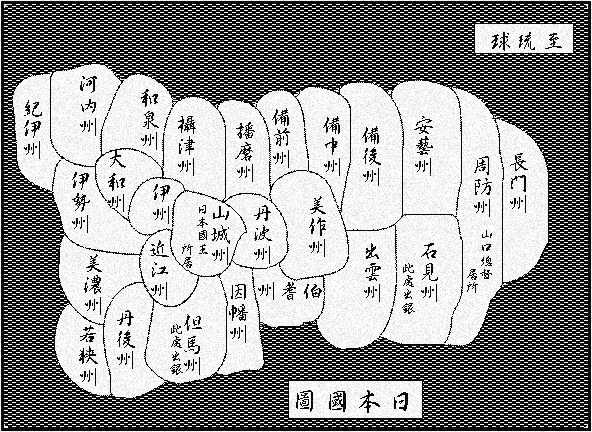
map of Rìběnguó
Mediæval and Renaissance Japan, however, are often popular with players of fantasy role-playing games. As a result, I am offering you a link to Sengoku Daimyo, a web-site devoted to this fascinating place and times. The web-site is maintained by Anthony J. Bryant, the author of Sengoku, the best feudal Japanese role-playing game ever, and of the following Osprey books: Early Samurai AD 200–1500 (Elite), The Samurai (Elite), Samurai 1550–1600 (Warrior), and Sekigahara 1600 (Campaign).

Take your time to explore the site... It is chock-full of great information.