Showing posts with label creature. Show all posts

2020-09-24

The Tiger in Vietnamese Lore

I have stumbled upon a very interesting post about tigers in Vietnamese legend and lore. The link is here, and I am copying the most relevant parts below just in case the original post should disappear from the internet (as it often happens); I am not trying to appropriate it!

The Godly Origin of the Tiger

In Vietnam, the tiger is also known as Chuá Sơn Lâm (The God of the Mountain and Forest). The creation myth of the tiger tells of a mutinous heavenly deity by the name of Phạm Nhĩ. While Phạm Nhĩ was remarkably strong and talented, he plotted against the Jade Emperor as he thought he would be a more worthy ruler of the Heavens. Phạm Nhĩ created a huge ruckus, and he was almost successful in his exploits, until Buddha intervened and captured him. Buddha handed him back to the Jade Emperor, but warned that Phạm Nhĩ should not be killed for his crime. Instead, he was reincarnated as an animal on Earth – but he still retained his extraordinary strength and hearing (the name Phạm Nhĩ refers to his long ears).

The Tiger and the Toad

I love finding common threads in tales around the world, and discovering the similarities between this story and The Turtle and the Hare, as well as The Banquet of the Twelve Zodiac, made me appreciate it all the more. In this story, a toad dissuade a tiger from devouring it by proposing a competition to see who can jump across the river first. During the jump, the toad hangs onto the tiger’s tail for most of the way, and leap across at the last moment to emerge as the victor. You can see the echoes of how the rat tricked its way to become the first member of the lunar zodiac sign, as well as the ever-present commentary between might and wit in fairy tales.

How the Tiger got Its Stripes

As a child, my favourite kinds of tales were the ones that attempted to explain the natural world around us. Like with many fairy tales, I am surprised at how dark it is now that I look back on it. The tale starts with a tiger who saw an ox being used as a beast of burden by a farmer. The tiger asked the ox why it willingly submitted to a human, when it was exponentially stronger. The ox replied it had to follow the human due to his cleverness, but could not explain what ‘cleverness’ was to the expectant tiger. The tiger then went to ask the farmer to show him this object called ‘cleverness’, and the farmer used the tiger’s curiosity to tie him to a tree and set him on fire (yes, folklore comes with a sobering dose of casual animal cruelty!). While the tiger escaped from the fire, it bore the burn marks from the event, and all tigers henceforth were burn with the black burn marks on their body. The ox? It fell over laughing when the tiger was caught and lost all of its upper teeth, which is why ox now only have teeth on their lower jaw. A two for one creation fable, so to speak.


Tigers in Our Language

Tigers are traditionally respected in Vietnam. Up until the past decade, it was still common practice to avoid referring to tigers as ‘con cọp’ or ‘con hổ’ (tiger), but instead using the titles of ‘ông’ (grandfather) or ‘cậu’ (uncle). In Southern Vietnam, the first born son was called ‘anh hai’ (second elder brother), as the title ‘anh cả’ (eldest brother) was saved for the tiger.

One of the most common folk name for a tiger is ‘Ông Ba Mươi’ (Grandfather Thirty), the name came from a rumored tradition once held. The emperors of yore would reward hunter who can catch a tiger with 30 quan tiền (an archaic Vietnamese currency, loan word from the Chinese 貫) as they prevented the destruction wrecked by tigers. However, they will simultaneously be punished by 30 lashes, for displacing the revered creatures from their natural habitat.

There are many Viet proverbs and ca dao (Vietnamese folk poetry) relating to tigers, one of the most well-known ones tells of the dominance of tigers over other landlocked creatures:

Trời sinh Hùm chẳng có vây,
Hùm mà có cánh, Hùm bay lên trời.

Loose Translation: The tiger was born without scales,
If the tiger had wings, it would fly to the heavens.

Vietnamese Folk Poetry

The poem puts forward that if tigers had scales like a fish, or wings like a bird, they would also dominate the sea and the sky. This is a call-back to the tiger’s godly origin, from a deity who almost became the Emperor of the Heavens.

Tigers are ubiquitious in Vietnamese idioms, a few examples are below. If you are versed in your Chinese idioms, you’ll notice the crossover because *gestures at the Viet colonial history*:

“Hùm dữ không ăn thịt con”
Translation: Vicious tigers won’t eat their own cubs.
Refers to the bonds between parent and child.
“Mình Hổ, tay vượn”
Translation: The body of a tiger, the hands of a monkey.
This saying is used to describe anyone who’s at the peak of their physical state: strong like a tiger and as agile as a monkey.
““Hổ ngồi rồng cuộn”
Translation: Crouching tiger, coiling dragon
If you’re familiar with the wuxia movie Crouching Tiger, Hidden Dragon, you already know what this means. In Vietnamese, it refers to a destination with hidden spiritual potential.
“Hổ phụ sinh hổ tử”
Translation: A tiger will father a tiger
Referring to the similarities between parent and child, as well as that insidious expectation that an accomplished parent would have an equally talented offspring.

Tigers in Legends

Like many other East and South-east Asian culture, Vietnamese also revere the Bạch Hổ (White Tiger). You can see a White Tiger carved onto the shrine near the famous Hoàn Kiếm lake in Hà Nội. In the ancient capital Huế, there are not just one, but two notable bridges that once went by the name of Bạch Hổ. One of them is now a popular tourist landmark of the city.

Legends of extraordinary men who defeat tigers with their bare hands are also passed on as an example of their might. You may already be familiar with Wǔ Sōng from the Chinese classic Water Margin, but Vietnamese have a similar figure in Mai Hắc Đế (Mai, the Black Emperor). Mai successfully led the uprising against Táng Dynasty rule in Vietnam in 722AD, and ruled for a short time over a region of the country. One of his backstory told of the slaying of a tiger by his bare hands to avenge his mother.

There are a few ethnic groups who claim the tiger as their ancestor, too. Myths tell of tigers (usually the White Tiger mentioned above), who took on human form, fell in love, and the children of these union became the descendants of tigers. Notable examples are prominent families bearing the surnames Vương, Bành, Dương, Điền, Đàm, Trướng, and Nhiễm. They migrated to Vietnam from the regions of Húběi, Húnán, and Sìchuān in China and carried these legends with them.

Urban Legend: The Three-Claws Tiger

The tiger’s hold on Viet people’s imagination is not a relic of the past. As recently as the 1940s, urban legend of the Cọp Ba Móng (The Tiger with Three Claws/Foot) haunted our thoughts. This was a fearsome tiger who feasted on human meat, there were many reasons proposed for its bias for human flesh – was it because it was used to devouring the corpses of our fallen soldiers? Perhaps it lived for so long that it was close to attaining human intelligence? There were also disputes on its origin, the most popular one being that it escaped from the menagerie of a wealthy French official. Having lost one of its foot in captivity, it turned its hatred and anger onto the Vietnamese villagers in the neighboring area. Among the brewing anti-colonial sentiment at the time, I can see why this theory held particular allure. In any event, it became the harbinger of death and military intervention was introduced to remove it. I can’t quite figure out what happened to the tiger on my readings, but it’s certainly a legend I will ponder for a long time.

2013-10-03

The Live-Lively (shēngshēng 猩猩)

The Live-Lively (shēngshēng 猩猩 or 狌狌) are legendary creatures mentioned several times in the Classic of Mountains and Seas (Shānhǎi Jīng 山海經).

The Live-Lively are good-natured simian humanoids that live close to salt water; this is supposed to be because of their connections with the Dragon Kings that rule the seas as they otherwise do not have any particular aquatic capabilities. Their most striking feature is their huge mane of reddish hair. They also have a tail of the same colour, and strikingly white ears. The rest of their fur is either greenish blue (青) or black.

The Live-Lively adore rice wine and go to great lengths to obtain it from humans. They can swallow incredible quantities of liquor without any harmful effects other than being even jollier than usual.

They have a special power which is knowing the name of any person they interact with.

Shēngshēng inhabit the coastal areas of China and Japan, and most of the islands between these two countries. They may also sometimes be found in the mountainous areas of south-west China.


Characteristics:
STR 3D6+3 (13-14)
CON 3D6 (10-11)
SIZ 3D6 (10-11)
INT 3D6 (10-11)
POW 2D6+6 (13)
DEX 3D6 (10-11)
APP 3D6 (10-11)

Move : 8
Hit Points: 11
Qì: 13
Damage Bonus: None
Armour: 1
Allegiance: Roll 1D100, 01-80: Daoism 1D6−4; 81-90: Daoism 1D6−2; 91-00: Buddhism 1D6−4
Morale: Mook

Skills:
Climb 40%, Dodge 40%, Hide 15%, Jump 30%, Knowledge (Region [Own]) 50%, Knowledge (Sea [Local]) 70%, Language ([Majority language of region]) INT×4%, Listen 35%, Sense 50%, Spot 25%, Swim 80%.

Special powers:
- Double CON when resisting effects of alcoholic beverages.
- Know name. A shēngshēng  will know the name of any person who interacts with it. Leaving an offering of rice wine to a shēngshēng counts as "interaction".

Attacks:
Brawl 40%, damage: 1D3+db (crushing)

Hit Location Table
1D20 | Hit Location | Hit Point Value
Tail | 01-02 | 1/5 total HP
R Leg | 03-05 | 1/3 total HP
L Leg | 06-08 | 1/3 total HP
Abdomen | 09-11 | 1/3 total HP
Chest | 12 | 2/5 total HP
R Arm | 13-15 | 1/4 total HP
L Arm | 16-18 | 1/4 total HP
Head | 19-20 | 1/3 total HP 

The unpublished British role-playing game Tetsubo, set in a fantasy version of Japan, made the Shōjō (Japanese pronunciation of 猩猩) available as a player character race. The Shōjō were described as smaller than humans (at an average height of 1.3m), and as having the following beginning skills: Etiquette and Consume Alcohol.

2013-05-14

Jade Boy

In Chinese folk religion, Jade Boys are divine servants of the Jade Emperor, acting as his ears and eyes in Heaven and on Earth, since the Emperor never leaves his heavenly palace.


A Jade Boy simply wills himself somewhere, and he is instantly transported to that place, unless some exceptionally strong magic prevents him from doing so. Since both the Orthodox and Heterodox Daoist traditions recognise the suzerainty of the Jade Emperor, and since a Buddhist would not interfere with the Jade Emperor's will, such magic must necessarily be of demonic or foreign origin (or both).

A Jade Boy can grant any wish, provided the Jade Emperor empowers him to do so. What usually happens is that, during an errand on Earth, a Jade Boy will meet a mortal in dire need of help. After having enquired about the needs of the person, and if he is moved by his or her plight, the Jade Boy will usually travel back to Heaven, wait for an audience with the Jade Emperor, and expose the person's problem and the solution he has thought of. If the Jade Emperor agrees to the solution, the Jade Boy is allowed to travel back to the petitioner and grant him or her a wish. Petitioners helped in this way are obviously always pure-hearted people with high an Allegiance score (>50) in one of the purely Chinese allegiances (Chinese folk religion, Daoism, Heterodoxy).

2013-04-07

[A-Z April Blogging] [G] Girl Lovely

Girl Lovely (Nǚ Wā 女媧) is a semi-historical figure mentioned in the Classic of Mountains and Seas (Shānhǎi Jīng 山海經) as a daughter of the Flame Emperor (Yándì 炎帝). She used to live in the northern regions and died by drowning in the East Sea, after which she was apotheosised and became a water goddess, worshipped by both the ancient Chinese and the Miáo. However, in the time periods contemplated by The Celestial Empire, Girl Lovely is not worshipped as a goddess any longer; she is rather considered as a mythological creature from the ancient past, much like the Droughtghoul (Hànbá, p118 of TCE) or the Plain Girl (p121 of TCE).

Girl Lovely is also considered as the sister and wife of Fúxī (伏羲), one of the semi-mythological rulers of ancient China. As sister and wife of Fúxī, she is often depicted with him as two embracing siren-like or snake-like beings with interlocked tails.

Even though Girl Lovely wasn't a goddess any longer in historical times, she still held great power. The downfall of the Shāng dynasty, for instance, is said to have been caused by the last Shāng ruler disrespecting her statue. She then sent the evil vixen spirit Dájǐ wreak havoc at the court of King Zhòu. These events are told in the Míng dynasty novel The Investiture of the Gods.

The GM can use Girl Lovely as an actual creature, a lamia-like temptress who tries to bewitch one of the characters and set him on the others. Or, as in The Investiture of the Gods, the PCs may stumble upon an ancient temple of Girl Lovely, and unwittingly call some curse upon themselves by reading some forbidden scripture; the rest of the adventure would consist in lifting the curse by fulfilling some quest for the goddess.

2013-02-17

Chīmèi

click to enlarge
I've found this picture on G+, made a search through Google Images to try and find out whence it came to give due credit, but to no avail. I wish I knew if there were other awesome pictures like this one. It's a vaguely East Asian-looking hobgoblin. This looks very inspirational for a Chīmèi (TCE p113).

I especially like the extra detail like the darkness character (闇) on the forehead of the Champion. It could be a spell matrix or something like that.

2012-09-17

White Bone Demon (Báigǔjīng 白骨精)

Despite their name and their appearance, White Bone Demons are not demons nor undead, but a humanoid race with translucent skin and organs. In a distance, only their skeleton can be seen, hence the misnomer. This is usually enough to cause most opponents flee in terror. Upon close inspection, and  in broad daylight, the translucent skin and organs can be dimly seen, and the white bone demon is exposed for what it really is: a mere humanoid creature.

A white bone demoness features prominently in the Journey to the West. She is constantly trying to confuse the protagonists so that they fail their quest, using all kinds of tricks, mainly illusions, since Báigǔjīng can create illusionary faces to appear as normal people (and then hide the rest of their translucent body using loose habiliments). A white bone demon will usually avoid hand-to-hand combat, relying on its tricks to harrass or drive away opponents.

Báigǔjīng inhabit the wastelands between China and the Barbarian lands that surround her.


Characteristics:
STR 3D6 (10-11)
CON 3D6 (10-11)
SIZ 2D6+6 (13)
INT 3D6 (10-11)
POW 3D6 (10-11)
DEX 3D6 (10-11)
APP 2D6 (7)

Move : 8
Hit Points: 12
Qì: 10
Damage Bonus: None
Armour: None
Allegiance: Roll 1D100, 01-60: Mārā's Path 2D10+30; 61-00: Heterodoxy 6D4+6
Morale: Leader

Skills:
Dodge 30%, Invisible in the dark 80%, Knowledge (Region [Own]) 75%, Language ([Majority language of region]) INT×5%, Resist Cold 60%, Sense 50%.

Spells:
Battle Magic: Illusion 80% [limited to own face, see above]

Attacks:
Mêlée weapon 30%, damage: per weapon+db (per weapon)

Hit Location Table: Use Humanoid


2012-02-13

Chuchuna (Чучуна)

I have found out that there is a bigfoot-like legendary creature called the Chuchuna in Eastern Siberia (that would be north of Outer Manchuria on the map on p28 of The Celestial Empire). Just like the Yěrén, about which I have already posted, the Chuchuna is not a mindless brute but a cunning hominid. The Chuchuna has been described as six to seven feet tall and covered with dark hair. The Chuchuna would hence have the exact same stats as the Yěrén (q.v.), except for the following:
SIZ 1D6+13 (16-17)
Hit Points: 15
Damage bonus: +1D4
Allegiance: Shamanism 10D6

For those who favour TCE-CoC crossovers... notice how 'Chuchuna' and 'Tcho-Tcho' sound similar! I know the sizes do not correspond, but then the Tcho-Tcho are said to have migrated from the Tibet to Southest Asia, so the change in size could reflect their having adapted to a region where competition for food is fiercer.

2012-01-03

The Money Tree (摇钱树)

The Money Tree (摇钱树 yáoqiánshù) is a nature spirit embodied in an ancient tree. It is hard to tell whether it moves about and appears to its victims, or if it is incorporeal and only materialises before them. Whatever the actual truth, the yáoqiánshù usually only appears before lone travellers. The GM may use the Money Tree when the PCs are lost in a forest and have lost track of each other, when they are fleeing a group of bandits in the mountains and are scattered, etc. The important element is that the victim must be alone.

The yáoqiánshù will choose to appear in the vicinity of the PC whose total Daoism + Heterodoxy allegiance score is the lowest. A slight breeze will ensure that the victim will clearly hear the tintinnabulation of the golden cash-like fruits of the Money Tree. The latter will present itself as a large specimen of whatever tree is most common in the area, its branches heavy with large, cash-like fruits made of the purest gold. The victim will be able to collect enough gold to go up one Wealth level. The large coins will be in imitation of whatever currency was official 1d8×100 years before present (this time span is actually the age of the yáoqiánshù). If the coins happen to correspond to cash that was in circulation during an earlier dynasty, and if the PC figures out he should sell them to a collector, then the Wealth of the PC will go up two levels!

This wealth, however, is cursed. At some later time, the GM should devise an unfortunate event that will cause the PC to lose all the accumulated wealth and to suffer misfortune, e.g., some local nouveau riche challenges the PC to a display of wealth through building an exaggerated mansion, which will then collapse upon the PC. Or a local cash-broken magistrate will request the PC build a bridge, or a temple, or whatever, which will cost him all the accumulated wealth plus some more. Or a travelling member of the imperial court will have heard about the wealth of the PC and will ask the PC to offer him some costly present, which he won't even like; this incident will make a bitter enemy of said member of the court... You get the idea.

2011-10-14

Yěrén (野人)


Several newspapers are currently running stories about the Yeti being for real — here's an example from the Guardian, a serious British newspaper.

The main difference with the usual Yeti stories is that in this case the creature does not inhabit the Himalayas but the Altai Mountains. In Celestial Empire gaming terms, this would place its home at the boundary between Western Siberia and Outer Mongolia.

Another difference is that apparently we're not talking about a brutish ape-like creature any longer, but about a cunning, more human-like creature, that has been able to keep its existence hidden from civilisation for centuries.

As a consequence, I would introduce the Yěrén (野人, this has traditionally been the name given to the Yeti in the Chinese language) to The Celestial Empire as a cunning, humanoid creature, possibly related to the Men of Leng of Lovecraft fame — if you favour this kind of cross-over. Yěrén could even be introduced as the waking world equivalents of the Men of Leng.

Characteristics:
STR 3D6 (10-11)
CON 3D6 (10-11)
SIZ 2D6+6 (13)
INT 3D6 (10-11)
POW 3D6 (10-11)
DEX 3D6 (10-11)
APP 2D6 (7)

Move : 8
Hit Points: 12
Qì: 10
Damage Bonus: None
Armour: Shaggy fur 1 point + may wear stolen armour
Allegiance: Roll 1D100: 1-60: Shamanism 10D6, 61-100: Heterodoxy 5D4
Morale: Average

Skills:
Craft (crude implements) 25%, Dodge 30%, Grapple 30%, Hide 25%, Knowledge (own region) 75%, Science (Natural History) 65%, Spot 40%, Stealth 60%, Throw 45%, Track 45%.

Spells:
Whatever spell a Yěrén knows will have been taught him by some "master" it serves/worships. This can be of particular interest in a cross-over Call of Cthulhu/Celestial Empire game, where said master can be a Moon-Beast, a priest of Nyarlathotep, or a cultist of the Black Lotus.

Attacks:
Heavy club 25%, damage: 1D8+db (crushing)

Hit Location Table: Use Humanoid.

2011-09-23

Creatures of the Cold Wastes (3)

Today, Hobgoblins are under the cold spotlight of the 'Cold Wastes' series of posts, even though they are not featured in the Fafhrd and Grey Mouser tales. Rather, they are a reminiscence of my early gaming days. As most gamers my age (I'm 43), I started with 1st ed AD&D. For some unfathomable reason, Hobgoblins in that game were invariably portrayed in Japanese armour and helmet. At the time, I was already fascinated with all things East Asian, hence the hobgoblin was a particularly beloved monster of mine.

Many years later, the Monstrous Compendium of 2nd ed AD&D had its 'hobgoblin' entry illustrated by the talented DiTerlizzi, who portrayed the hobgoblin with an Inner Asian rather than East Asian demeanour. Again, this illustration struck me as very evocative of an imaginary Inner Asian cold wilderness inhabited by dangerous humanoids.

I've borrowed the illustration for today's post. For a Celestial Empire game, and given its vaguely Mongolian outfit, I will consider this creature as an Inner Asian variant of the more civilised Chīmèi (魑魅 – see p113 of the rule book), and call it a Dímèi (狄魅 – 狄 means 'Northern barbarian', and 魅 is short for 魑魅).

Differences with the Chīmèi as described on p113 of the rule book:
  • Lamellar armour 6 AP, and round shield
  • spells: only INT/4 spells are known
The above modifications are to convey the idea that the Dímèi rely more on brute force and less on sorcery than their Southern brethren...

2011-09-22

Creatures of the Cold Wastes (2)

Despite Ice Gnomes being featured several times in the adventures of Fafhrd and the Grey Mouser when they are in the Cold Wastes, detailed information about them is scant. For a Celestial Empire game, I would treat them as a peculiar subspecies of Tǔxíng (土行 – Earth Travellers, see p120 of the rule book) who are able to travel under snow and ice rather than underground. Their name should hence be changed to Xuěxíng (雪行 – Snow Travellers), to reflect their change in nature.

The Xuěxíng's appetite for beautiful girls is just as strong as the Tǔxíng's.

The Xuěxíng use ice pellets as missiles for their slings.

Characteristics:
STR 2D6+6 (13)
CON 2D6+9 (16)
SIZ 1D6+4 (7-8)
INT 2D6+6 (13)
POW 3D6 (10-11)
DEX 3D6 (10-11)
APP 2D6+1 (8)

Move : 6
Hit Points: 12
Qì: 10
Damage Bonus: None
Armour: Hair shirt 1 point
Allegiance: Roll 1D100: 1-30: Daoism 5D6+20, 31-100: Heterodoxy 5D6+20
Morale: Average.

Skills:
Dodge 40%, Knowledge (Region [own]) 35%, Knowledge (Religion: Daoism) 40%, Listen 45%, Literacy (Classical Chinese) 90%, Spot 45%, Swim 05%.

Spells:
(Battle Magic) – Travel under ice/snow (each Qì point spent allows the Xuěxíng to travel 2 lǐ under ice/snow) 90%.
(Daoist Magic) – As per the rules.

Attacks:
Axe 40%, damage:1D6+1+db (bleeding)
Sling 30%, damage: 1D6+½db (crushing)

Hit Location Table: Use Humanoid.

2011-09-21

Creatures of the Cold Wastes (1)

I am currently re-reading the Fafhrd and Grey Mouser stories by Fritz Leiber. I am particularly fond of the ones set in the Cold Wastes of Nehwon. Many creatures of the Cold Wastes would obviously be at home on the high plateaux of Tibet or in the cold mountains of Western Siberia.


The Snow Serpent is exactly such a creature. Despite its name, it is really a mammal that preys upon unwary travellers and their beasts of burden.

Particularly primitive or superstitious tribes consider the Snow Serpent as a divine animal and avoid killing it. Some others hunt it actively because of the quality and the beauty of its snow-white fur.

The following stats are partially inspired from the Lankhmar supplement for MRQ.

However, after having read the relevant novel, I cannot quite understand why the poison of the Snow Serpent was described as a cloud breathed by the animal or as spat poison. In the novel, Fafhrd is clearly victim to the poison because he's been bitten.


Characteristics:
STR 4D6+12 (26)
CON 4D6+6 (20)
SIZ 4D6+12 (26)
INT 7 (7)
POW 3D6 (10-11)
DEX 3D6 (10-11)

Damage bonus: +2D6
Hit Points 23
Move 8

Skills:
Climb 75%
Dodge 25%
Hide 80% on a white background, 40% otherwise
Sense 50%
Stealth 90% on a white background, 45% otherwise
Tracking 30%

Attacks:
Bite 50%, damage 1D8+½db (bleeding) + poison (see below).

Effects:
-Poison
The poison of the snow serpent has a numbing effect. Its POT is equal to the SIZ of the serpent. If it rolls successfully on the Resistance Table vs the CON of the victim, the affected hit location is useless for 1D6 hours.

Armour: Thick fur 2 points

Hit Location table: Use Snake

2011-07-18

The Hǎiruò (海若)

This post is for those of you who are keen on a Celestial Empire-Call of Cthulhu crossover.

The Hǎiruò, or sea genie, is a little-known yāoguài from Daoist mythology. I suggest that it should be used as the Chinese equivalent to Lovecraft's Deep Ones.

The Hǎiruò live in the sea between China and the Ryūkyū Islands. The Míng policy of clearing coastal areas of all population (see my 28 June post) has enabled the Hǎiruò to settle in small, hidden hamlets on the south-eastern coast of China. Imagine the potential for not one, but a string of Innsmouth-like ports, complete with their hybrid inhabitants.

The Hǎiruò serve the Dragon King of the East Sea (Dōnghǎi Lóngwáng 東海龍王), a major Heterodox immortal being. They fear the Sea goddess Māzǔ (媽祖).

Characteristics:
STR 4D6 (14)
CON 3D6 (10-11)
SIZ 4D6 (14)
INT 3D6 (10-11)
POW 3D6 (10-11)
DEX 3D6 (10-11)
APP 2D6 (7)

Move : 8 (10 swimming)
Hit Points: 12
Qì: 10
Damage Bonus: +1D4
Armour: Skin 1 point + possibly some bespoke made armour adding up to 3 points
Allegiance: Heterodoxy 5D4+15
Morale: Leader

Skills:
Dodge 25%, Knowledge (Region: East China Sea) 75%, Knowledge (Region: South China Sea) 50%, Language (southern Chinese language or dialect) 80%, Language (other [possibly Formosan and/or Ryukyuan]) INT×5%, Sense 40%, Swim 90%.

Spells:

Demoralise 80% [but use of this spell doesn't increase the Heterodoxy Allegiance score of the Hǎiruò].

Attacks:
Claw 25%, damage:1D6+db (bleeding)
or
Pole arm 25%, damage: per weapon+db (per weapon)

Hit Location Table: Use Humanoid.

2011-07-10

Mongolian Death Worm

Note: This is the second post in the series of 'blog swapping' posts with Scott.

The Mongolian death worm is a vicious predator that lives in the deserts between Mongolia and China proper. The Steppe nomads, whose economy is extremely dependent on animal husbandry, rightly fear this creature because of its fondness for the meat of oxen, goats, and horses.

Despite its name, the Mongolian death worm looks more like a dark red snake, 50- to 150-cm long. Its head and its tail are difficult to tell from each other because the Mongolian death worm has no visible eyes, nostrils or mouth.
The Mongolian death worm moves undetected under the sand of the desert and springs out to attack its victim, by either spraying a deadly poison or acid at the victim or by emitting electrical charges. The range and the effect of these attacks is as per below.

Characteristics:
STR 2D6+6 (13)
CON 2D6+6 (13)
SIZ 1D6+1 (4-5)
INT 3
POW 3D6 (10-11)
DEX 2D6+3 (10)
Damage bonus: N/A (only ranged attacks)
Hit Points 9
Move 8

Skills:
Stealth 75%

Attacks:
Poison spit - 75%
Acid spray - 75%
Electrical charge - 60%

Effects:
-Poison
Range: 4m
The POT of the poison is equal to the CON of the Mongolian death worm.
-Acid
Range: 6m
This is a very strong acid (see p211 of BRP) that corrodes anything it touches.
-Electricity
Range: 6m
This causes 3D6 of damage if the target is at less than 2m; 2D6 less
than 4m; 1D6 less than 6m.

Armour: Skin 2 points

Hit Location table
1D20 | Hit Location | Hit Point Value
1-8 | Tail | 1/3 total HP
9-16 | Body | 2/5 total HP
17-20 | Head | 1/3 total HP

Please go and check out Scott's T&T version of the Mongolian Death Worm now.

2011-06-14

Asura


Asura are potent creatures from Vedic mythology: demonic and titanic spirits that are opposed to the Deva (the Indian gods), and in particular to Indra. There are four kinds of Asura, depending on their birth: born out of an egg, out of a womb, out of magic, out of water. Asura live deep in mountain caverns, in the underworld, and in the nether regions where the Asura architect-magician Maya has built them huge cities. Asura also live in the sea that surrounds Mount Sumeru.
In Buddhism, the Asura realm is the lowest of the six domains of rebirth. However the Asura are generally depicted as less evil than their Vedic counterparts; their behaviour stems from their karma: it is assumed that rebirth into an Asura is the consequence of having been a human being obsessed with force and violence, always looking for an excuse to get into a fight, angry with everyone and unable to maintain calm or solve problems peacefully.

Asura as creatures for a Celestial Empire game are described on p123 of the rule book. Depending on their birth, Asura may be further characterised as follows:

Egg-born Asura inhabit the flying fortresses that circle Mt Sumeru. They have huge bird-like wings which they use to glide down from their flying fortress when attacking the sky-realm of the Deva.
Womb-born Asura mostly live undergound. They are known for their armour and weapons, and in particular for their superior bows. They are mortal but their lifespan is still immeasurable by human standards. They are the most likely to strive for a better rebirth and hence lend an ear to Buddhist preaching.
Magic-born Asura shun the use of armour and weapons and prefer concentrate on the use of spells.
Water-born Asura are the most wicked ones. They have a craving for alcoholic drinks.

Chinese name: 阿修羅, Romanised as Āxiūluó

2011-06-04

The Headless Giant (Xíngtiān 刑天)

Note: This post is the first in a series of 'blog swapping' posts I'll be doing with Scott, the author of the excellent Trollish Delver blog.
The Xíngtiān is a creature from the Chinese classic bestiary, the Shānhǎi Jīng. The latter is a very old book whose creatures do not feature prominently in Chinese fiction. This is why the Xíngtiān does not appear in The Celestial Empire. However, the Xíngtiān has recently undergone a surge in popularity in China because of its appearance in a number of on-line adventure games (see here and there). As a consequence, I have decided to make it available for Celestial Empire campaigns.

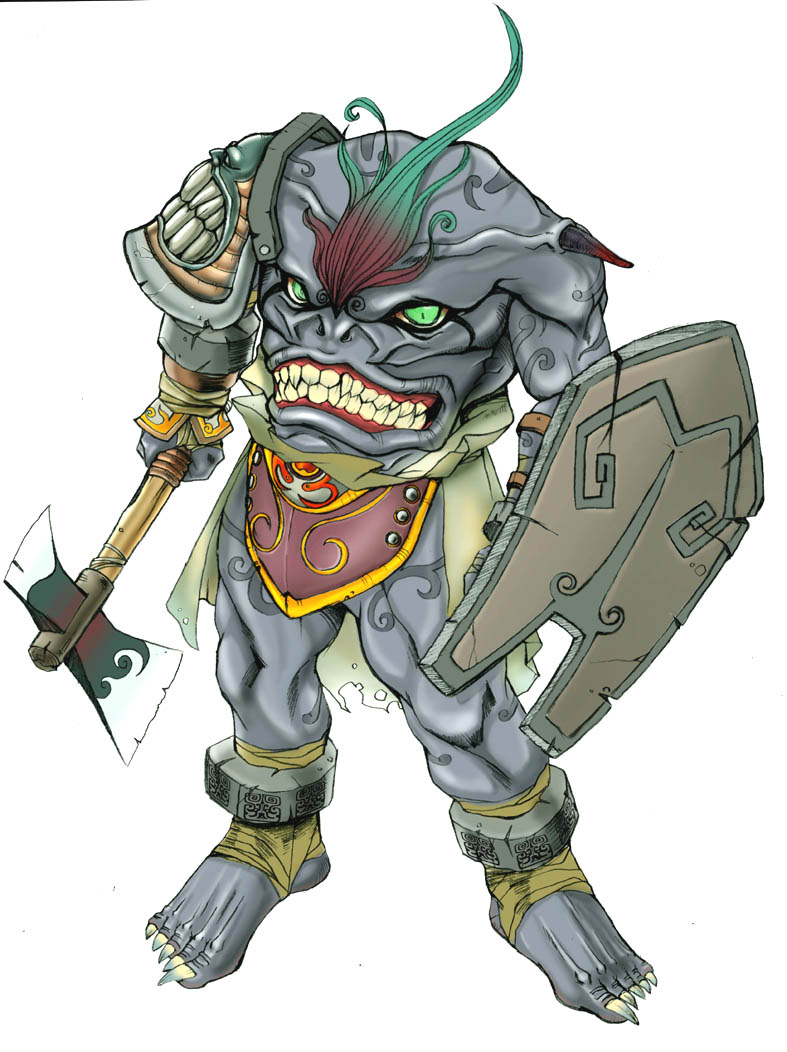
The Xíngtiān is a very ancient humanoid who predates even the most ancient Chinese chronicles. It is mentioned as an adversary in the battles fought by the Yellow Emperor in pre-dynastic times. It is told that the Xíngtiān challenged the Yellow Emperor for a duel; in the ensuing fight, the Yellow Emperor beheaded the giant humanoid. However, the blow did not kill the Xíngtiān; the monster fled without its head. From that time on, it used its nipples as eyes, and its navel as a mouth. According to the Shānhǎi Jīng, the Xíngtiān fights with an axe and a shield.

Characteristics:
STR 4D6+6 (20), CON 4D6 (14), SIZ 4D6+6 (20), INT 3D6 (10-11), POW 3D6 (10-11), DEX 3D6 (10-11), APP 1D6 (3-4).
Move: 10, Hit Points: 17, Damage Bonus: +1D6, Armour: 0.
Allegiance: Heterodoxy 5D4+5
Morale: Leader.
Skills: Climb 35%, Dodge 25%, Jump 30%, Knowledge (Region [Mountains]) 75%, Listen 25%, Science (Natural History) 20%, Spot 30%, Stealth 25%, Track 60%.
Spells: If the Xíngtiān has an INT greater than 12 it knows the following Battle Magic spells: Befuddle, Dispel, Heal, Mobility, Protection, with a skill value of 30%.
Attacks:
Giant axe 55%, damage: 2D8+2+db (bleeding)
Long Shield
Special defence:
Swallows weapon: whenever the Xíngtiān is hit in the Abdomen, it may swallow the weapon of its attacker on a successful STR vs STR roll on the Resistance table. Damage is still inflicted though.

Hit Location table
1D20 | Hit Location | Hit Point Value
1-5 | Right Leg | 1/3 total HP
6-10 | Left Leg | 1/3 total HP
11-13 | Abdomen | 2/5 total HP
14 | Chest | 1/2 total HP
15-17 | Right Arm | 1/4 total HP
18-20 | Left Arm | 1/4 total HP

Please go and check out Scott's T&T version of the Xíngtiān now. I'm amazed at how he's captured the monster's peculiarities using T&T's system.

2011-04-27

The Plain Girl (Sùnǚ 素女)


The Plain Girl knows the sexual techniques to heal, but she also knows the ones to steal qì from a victim. A character who is a member of the Xié Sect, and who successfully resists the Plain Girl’s attempt to seduce him, may in turn try to seduce her trough an opposed skill roll of his Heterodoxy allegiance against the Plain Girl’s Charisma. If the character has rolled successfully, the Plain Girl will teach him her secret technique to steal qì from a sexual partner. For every night spent in company of a partner of the opposite sex, the character can now definitively ‘transfer’ 1 CON characteristic point from the victim to himself. The victim will appear to age 5 years for each characteristic point lost in this way – which may eventually arouse suspicion in her relationship.