Showing posts with label crossover. Show all posts

2020-07-06

Colonial Vietnam Cthulhu KS

Only tangentially relevant to this blog but still... I have found it interesting.

There is a crowdfunding campaign going on to fund a set of Call of Cthulhu 7th edition adventures cum background set in colonial Vietnam, circa 1925-1955. Some content is specific to WWII-era adventures, but some ideas could easily be stolen for a TCE/CoC cross-over game set in Vietnam, in particular the Hòa Hảo Buddhist militias, the entities that offer the temptation of enlightenment, the Expédition Lemont to the mythical city of gold, and the possibility to tie in the Plateau of Leng with Southeast Asia.

See p128 of The Celestial Empire for further details on running cross-over adventures with the Call of Cthulhu game.

2013-04-18

[A-Z April Blogging] [Q] Qelong Valley

The imaginary Qelong Valley in Cambodia is the setting of the upcoming sandbox-like supplement The Valley of the Lost Shell, by Kenneth Hite, for the Lamentations of the Flame Princess Weird Fantasy Role-Playing game. If you are unfamiliar with LotFP, its supplements specialise in dark, even sinister, fantasy tales approximately set in 16th- or 17th-century Europe. The Valley of the Lost Shell is going to be LotFP's first foray into an Asian-flavoured setting.

click to enlarge


Here is a brief presentation of The Valley of the Lost Shell by Ken Hite himself:
"The Valley of the Lost Shell is a classic 'exploration' adventure, set in a wet, poisoned sandbox. [...]  I see the Qelong Valley as a land of steam, smoke, mist, fog – high grasses and low mangroves, like the Dead Marshes or Beowulf’s fen country. All of this grows not in a placid pastoral Olden Tyme, or even a gently corroded Dark Age, but in the path — or technically on the sidelines — of a great and incomprehensible war. Houses and farms are burned, villagers gaunt and feral. Dogs whine over the carcasses of their masters, then tear out the intestines to feed themselves. Men kill each other for a handful of rice, or for a woman who can be beaten into cooking it. All around, sorcerous echoes and explosions ripple the skies, but as a constant drumbeat of vile thunder, not as anything aimed at anyone in the same country. The Qelong Valley has been poisoned by accident and forgotten by its killers. Only the scavengers remain, and the worms that grow in the corpse.
Magical fallout, the elephant lich, the hundred-mile-long naga, the Lotus Monks, the insect-possessed myrmidons, and so much more... different than anything LotFP has done so far, that's for sure."


Elephant lich? Hundred-mile-long naga? Lotus Monks? Colour me interested :-)

2013-02-15

Lan Xang Goodness!

Lan Xang was a Lao kingdom that lasted from 1354 to 1707, i.e., from the Yuán until the early Qīng in Chinese terms. Lan Xang appears at the bottom of map No.1 on p28 of The Celestial Empire.

There's been a recent article by Bryan Thao Worra, a Lao-American short story writer, on the Innsmouth Free Press web-site, which provides a lot of Cthulhuesque adventure ideas in Lan Xang. Obviously, a lot of those ideas can be ripped off for a cross-over CoC/TCE game, or even for a regular high-fantasy TCE game.

I am copying the juicy parts of the article below:

Once known as the "Realm of a Million Elephants", Laos today is home to over sixty different documented cultures, each with its own languages, epics and customs. A nation the size of Great Britain, Lao geography is 70% jungles and mountains, with many ancient temples and ruins, even the mysterious Plain of Jars, filled with giant urns of unknown purpose.

There are plenty of beings from the Cthulhu Mythos created during the 20th century who’d fit right into a Lovecraftian Lao horror story. Consider the Tcho-Tcho and the Crawling Chaos, Nyarlathotep, Yig, the Father of Serpents, elephantine Chaugnar Faugn, the serpent people, or freshwater Deep Ones plying the Mekong before swimming into the cryptic depths of the Pacific.

Plenty of figures from Lao legends more than fit the bill as Lovecraftian entities. The Lao regard the Nak, or Nāga
(TCE p125), as sacred protectors, particularly of the teachings of the Buddha. These are shapeshifting, serpentine beings imbued with magic powers and a capacity for terrible vengeance on anyone who despoils their sacred streams, rivers, lakes, or hidden caverns. But I advise you to treat them respectfully within your story.

There are also the Nyak, who have their roots in the Rākshasa legends of India
(TCE p125-6). They are giant, horrific anthrovores of remote wildernesses. Some swore to protect the teachings of the Buddha. Others have far, far different designs. Lao legends are filled with legends of terrifying roaming weretigers, half-bird women, hungry ghosts, flying horses, and mystic hermits. With a little digging, a writer finds amazing opportunities.

The Hmong in Laos have numerous entities who invoke dread and fear, such as the poj ntxoog, a nightmarish malignant hag hungry for human flesh. One forest spirit is known to approach mountain farmers at night, its arrival heralded by poultry exploding or pigs turning inside out. The classic Hmong legend of "The Orphan and the Zaj", an aquatic dragon-like being, was retold in the early 1980s as a comedy, but, when read correctly, should more likely be interpreted as a terrifying adventure with Lovecraftian undertones.


[...]

Most traditional Lao epic myths are poorly translated into English, seemingly inconsistent, incomplete and even contradictory. Sometimes, they’re horribly abridged; other times they’re incoherently voluminous. For the Lovecraftian writer, this should be rather familiar and almost reassuring territory to wade into.

An excellent online resource for Lao folktales can be found at Northern Illinois University, which houses a free archive of many English translations of Lao legends and myths.

I would particularly highlight the translation of Phra Lak Phra Lam, which is a Lao take on the Indian epic of the Rāmāyana. Featuring warrior monkeys known as "vanon", titanic
Nāga kings, mermaid generals, shapeshifting monks, villainous giant Rākshasa on an island fortress and spells aplenty, it would be simplicity itself to set a sword and sorcery tale within this story, especially one with the classic trappings of the Mythos.

Phadaeng Nang Ai is another tale with significant potential. It’s a love triangle between the
Nāga prince Phangkhi, a human princess named 'Aikham', and the human king Phadeng. The aspect of interest for Lovecraftian writers is the revenge of the Nāga king, Suttho, who leads an army of Nāga to kill everyone in King Phadeng’s realm for eating Prince Phangkhi. The Nāga king seizes Princess Aikham to live in the fabled underwater Nāga city of Badan. King Phadeng’s solution is to end his own life so he can become a ghost king who rallies a ghost army to seize his beloved back. If you can’t work with that, turn in your elder signs.

2012-08-18

Seven Cryptical Books of Hsan

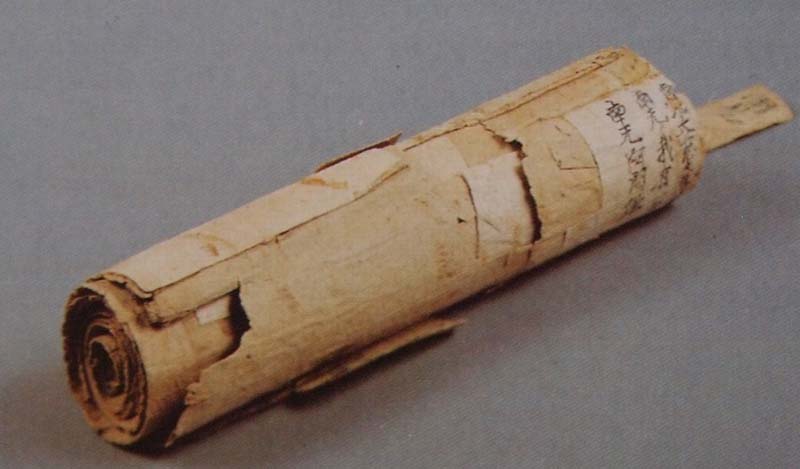
The Seven Cryptical Books of Hsan is a collection of fictional writings mentioned by Lovecraft in "The Other Gods" (1921) and "The Dream-Quest of Unknown Kadath" (1926). The books (or rather scrolls) are supposed to have been written in Classical Chinese around the 2nd century AD by the Chinese philosopher Hsan the Greater [although Hsan is not even a Chinese-sounding name]. The books allegedly contain information parallelling that contained in the Yìjīng, but with an esoteric rather than exoteric bent. Each scroll covers a specific subject:
  • Scroll One: the works of Huángdì, the Yellow Emperor, his miraculous inventions and cures.
  • Scroll Two: ritual cannibalism and ghoulish cults.
  • Scroll Three: spirits of the air.
  • Scroll Four: spirits of the water.
  • Scroll Five: Deep Ones off the south China coast and their human devotees; space and time: the hounds of Tindalos and the Liao drug.
  • Scroll Six: the Plateau of Leng in Central Asia and Unknown Kadath; their history and inhabitants.
  • Scroll Seven: a Mythos primer.
The Seven Cryptical Books of Hsan may thus be used much like the Yìjīng, but with a more sinister twist to its use. For instance using the Seven Cryptical Books of Hsan instead of the Yìjīng for a Divination skill roll (p59 of The Celestial Empire) may yield a darker bent to the results of the roll, or even ill-fated side effects. Using the example in the rule book, White Fox may want to follow the black falcon; however after having travelled through the mountains undetected by the guards in the fort, she may make more unsavoury an encounter, like a lone hermit dabbling in the black arts or even a Mythos-inspired creature...

Similarly, if the Seven Cryptical Books of Hsan are used instead of the Yìjīng for a Necromancy skill roll (p63 of TCE) the monster summoned or the answers received will certainly contain Mythos-inspired elements...

On top of their use as an alternative, sombrer version of the Yìjīng, the Seven Cryptical Books of Hsan contain useful information for player characters.
  • Scroll One will impart bonuses to characters using cure-like skills and/or spells.
  • Scroll Two contains information about Chinese ghouls (wǎngliáng). This kind of information enables Monster Hunters (see p54 of TCE) to create secret recipes to fight against wǎngliáng.
  • Scrolls Three and Four impart bonuses to the Conjure Elemental spell.
  • Scroll Five contains information about the Hǎiruò. This kind of information enables Monster Hunters (see p54 of TCE) to create secret recipes to fight the Hǎiruò.
  • Scroll Six gives +20% to Knowledge (Region [Central Asia]) and/or to Knowledge (Region [Tibet]) in any cross-over CoC/TCE campaign game.
  • Scroll Seven gives +20% to Knowledge (Religion [Cthulhu Mythos]) in any cross-over CoC/TCE campaign game.

Perusing these scrolls may increase the Cthulhu Mythos Allegiance score of the reader (if used) or, alternatively, reduce the Buddhism allegiance score/increase the Heterodoxy allegiance score by 1 for each scroll read.

2012-04-03

Chinese-themed Dreamlands

I am a long time fan of HP Lovecraft's Dreamlands and, as is obvious if you are reading this blog, of all things Chinese.

There are many instances in Chinese literature and folk tales of men travelling to a kind of Chinese equivalent of the Dreamlands, which are usually portrayed as a place where the society of men is replaced by that of animals like ants or of mythological beings like dragons, but being in all other aspects very similar to Imperial China. Thus dragonfolk exhibit the same filial piety as the Chinese do, and the society of ants is governed by the same laws as that of the Chinese.


An extremely famous example is the Táng dynasty tale titled the Governor of the Southern Tributary State, in which a disappointed scholar and military man dreams up an entire lifetime of promotion, war, honour, marriage, family and demotion as the governor of the prosperous tributary state of Nánkē, only to suddenly wake up and slowly become aware that it was but a dream, and that a mere half-day has passed in the waking world. The startled man looks around himself, slowly readjusting to reality, and eventually noticing a large ants' nest. The man closely observes the ants' nets and is shocked at the realisation that it is in all aspects identical to the province of which he was the governor. Because of the popularity of this folk tale, the phrase "dream of Nánkē" has become synonymous in Chinese with "inanity of human ambition".

There are other similar tales, and they usually end with some moral teaching. As we can see, whereas Lord Dunsany's or HP Lovecraft's dream-tales are escapist in nature, the Chinese ones are edifying. Which doesn't mean we as players shouldn't enjoy dreamland adventuring in a Chinese setting :)

2012-02-13

Chuchuna (Чучуна)

I have found out that there is a bigfoot-like legendary creature called the Chuchuna in Eastern Siberia (that would be north of Outer Manchuria on the map on p28 of The Celestial Empire). Just like the Yěrén, about which I have already posted, the Chuchuna is not a mindless brute but a cunning hominid. The Chuchuna has been described as six to seven feet tall and covered with dark hair. The Chuchuna would hence have the exact same stats as the Yěrén (q.v.), except for the following:
SIZ 1D6+13 (16-17)
Hit Points: 15
Damage bonus: +1D4
Allegiance: Shamanism 10D6

For those who favour TCE-CoC crossovers... notice how 'Chuchuna' and 'Tcho-Tcho' sound similar! I know the sizes do not correspond, but then the Tcho-Tcho are said to have migrated from the Tibet to Southest Asia, so the change in size could reflect their having adapted to a region where competition for food is fiercer.

2011-12-18

Using LotFP supplements with TCE

Thanks to a recent sale on the PDF versions, I have recently bought quite a few LotFP supplements. For those of you who have spent the last two years on Mars, Lamentations of the Flame Princess (LotFP) is a weird fantasy role-playing game, which is part of the "Old School Renaissance" (OSR) movement. However, contrary to most OSR fantasy role-playing games, whose sole aim is to re-create that 'dungeon' feeling from our high school years, LotFP has a few innovations of its own, which I'll detail in this post. These are much more important in my eyes than what LotFP is usually only known for: a general taste for adult themes and illustrations.

1. To me, the most important innovation is that LotFP adventures, for all their 'dungeonness', are definitely different from those 1980s modules: they are usually designed for low-level characters, and there is only one major opponent within the 'dungeon' -- the rest of the dungeon is there to unnerve the PCs through its many traps or weird encounters.

2. Another peculiarity of LotFP is that its default setting, although never really described, is more of a 15th-17th century Europe than an imaginary Dark Ages quasi-European fantasy world. Again, this makes for grittier adventures where the enemy is not an exaggerated 'monster' but a cunning, evil enemy that has laid out a careful plan to trap unwanted trespassers.

3. Yet another peculiarity is that LotFP adventures tend to be light on stats and heavy on description. A creature's armour class, for instance, is never given as a numeric value but always as "as unarmored man", "armor as leather", etc. Movement is likewise always rendered as a multiplier of an unarmoured man's movement value.

As a consequence, LotFP adventures are surprisingly adaptable to The Celestial Empire. I have started penning conversion notes for No Dignity in Death, The Tower, and Tower of the Stargazer. Since I don't want to spoil these adventures, I won't write anything here. Just PM me or let me know in the comments if you are interested.

2011-10-14

Yěrén (野人)


Several newspapers are currently running stories about the Yeti being for real — here's an example from the Guardian, a serious British newspaper.

The main difference with the usual Yeti stories is that in this case the creature does not inhabit the Himalayas but the Altai Mountains. In Celestial Empire gaming terms, this would place its home at the boundary between Western Siberia and Outer Mongolia.

Another difference is that apparently we're not talking about a brutish ape-like creature any longer, but about a cunning, more human-like creature, that has been able to keep its existence hidden from civilisation for centuries.

As a consequence, I would introduce the Yěrén (野人, this has traditionally been the name given to the Yeti in the Chinese language) to The Celestial Empire as a cunning, humanoid creature, possibly related to the Men of Leng of Lovecraft fame — if you favour this kind of cross-over. Yěrén could even be introduced as the waking world equivalents of the Men of Leng.

Characteristics:
STR 3D6 (10-11)
CON 3D6 (10-11)
SIZ 2D6+6 (13)
INT 3D6 (10-11)
POW 3D6 (10-11)
DEX 3D6 (10-11)
APP 2D6 (7)

Move : 8
Hit Points: 12
Qì: 10
Damage Bonus: None
Armour: Shaggy fur 1 point + may wear stolen armour
Allegiance: Roll 1D100: 1-60: Shamanism 10D6, 61-100: Heterodoxy 5D4
Morale: Average

Skills:
Craft (crude implements) 25%, Dodge 30%, Grapple 30%, Hide 25%, Knowledge (own region) 75%, Science (Natural History) 65%, Spot 40%, Stealth 60%, Throw 45%, Track 45%.

Spells:
Whatever spell a Yěrén knows will have been taught him by some "master" it serves/worships. This can be of particular interest in a cross-over Call of Cthulhu/Celestial Empire game, where said master can be a Moon-Beast, a priest of Nyarlathotep, or a cultist of the Black Lotus.

Attacks:
Heavy club 25%, damage: 1D8+db (crushing)

Hit Location Table: Use Humanoid.

2011-08-03

The Cloudsoul (hún 魂)


It is believed in Traditional Chinese Medicine that the cloudsoul (hún) has an influence on all nocturnal activities, and more peculiarly upon sleep and dreaming. According to the wǔxíng system of correspondences, each phase has a complex series of associations with different aspects of nature; in particular, the cloudsoul is associated with liver-yīn. As a consequence, if liver-yīn is deficient, the hún is deprived of its residence and wanders off at night, causing a restless sleep with many tiring dreams. If liver-yīn is severely depleted, the cloudsoul may even leave the body temporarily at night during or just before sleep.

This brings forth an opportunity for a Celestial Empire/Cthulhu Dreamlands crossover where the player characters are somehow depleted of their liver-yīn (through a yīn-sucking creature?) and find themselves in (possibly a Chinese version of) the Dreamlands. Then they might either stay there and have further adventures in the Dreamlands, or try and find a means to return to the Waking World.

2011-07-18

The Hǎiruò (海若)

This post is for those of you who are keen on a Celestial Empire-Call of Cthulhu crossover.

The Hǎiruò, or sea genie, is a little-known yāoguài from Daoist mythology. I suggest that it should be used as the Chinese equivalent to Lovecraft's Deep Ones.

The Hǎiruò live in the sea between China and the Ryūkyū Islands. The Míng policy of clearing coastal areas of all population (see my 28 June post) has enabled the Hǎiruò to settle in small, hidden hamlets on the south-eastern coast of China. Imagine the potential for not one, but a string of Innsmouth-like ports, complete with their hybrid inhabitants.

The Hǎiruò serve the Dragon King of the East Sea (Dōnghǎi Lóngwáng 東海龍王), a major Heterodox immortal being. They fear the Sea goddess Māzǔ (媽祖).

Characteristics:
STR 4D6 (14)
CON 3D6 (10-11)
SIZ 4D6 (14)
INT 3D6 (10-11)
POW 3D6 (10-11)
DEX 3D6 (10-11)
APP 2D6 (7)

Move : 8 (10 swimming)
Hit Points: 12
Qì: 10
Damage Bonus: +1D4
Armour: Skin 1 point + possibly some bespoke made armour adding up to 3 points
Allegiance: Heterodoxy 5D4+15
Morale: Leader

Skills:
Dodge 25%, Knowledge (Region: East China Sea) 75%, Knowledge (Region: South China Sea) 50%, Language (southern Chinese language or dialect) 80%, Language (other [possibly Formosan and/or Ryukyuan]) INT×5%, Sense 40%, Swim 90%.

Spells:

Demoralise 80% [but use of this spell doesn't increase the Heterodoxy Allegiance score of the Hǎiruò].

Attacks:
Claw 25%, damage:1D6+db (bleeding)
or
Pole arm 25%, damage: per weapon+db (per weapon)

Hit Location Table: Use Humanoid.