2011-06-08

Niǎn Rebellion


The Niǎn 捻 Rebellion is one of the many rebellions that brought economic devastation and loss of life at the end of the Qīng 清.

The uprising started with popular agitation brought about by a secret society, which may or may not have been linked to the White Lotus Society (see p94 of the rule book). The rebellion took place in northern China from 1853 to 1868; the most heavily affected areas were the provinces of Shāndōng 山東, Hénán 河南, Ānhuī 安徽, and Jiāngsū 江蘇 [roughly corresponding to the eastern part of "North China" and to the northern part of "Lower Yángzi" on the map on p28 of the rule book].

The Niǎn rebels sport long, loose hair, in open contrast to the Qīng-imposed Manchu hairstyle (the waist-long braided pigtail). The Niǎn are excellent horsemen who, after each attack against imperial troops, retreat into their fortified villages. The Niǎn — and this will be their undoing — do not have a precise political goal; they are mostly unmarried, dispossessed young peasants, ruined merchants, starving scholars: the aim of their attacks is looting.
The Niǎn seldom co-operate with the Tàipíng 太平. But after the defeat of the latter and the establishment of the Treaties of Tiānjīn with the western powers, the imperial government devotes its full military forces to quell the Niǎn Rebellion.

2011-06-07

The Chinese Underworld


In ancient Chinese religion the Underworld was called the Yellow Springs (Huángquán 黄泉) — possibly a reference to the ubiquitous Yellow River. The Yellow Springs were not a ‘hell’ where one suffers retribution but rather a place where the souls of the departed were supposed to reside, the destination of the whitesoul ( 魄). Life could be made easier for the if it was provided with the necessary amenities: food, clothing, money, precious objects, and servants. These would be placed in the tomb by the surviving relatives. The servants (human and animal) were at first provided by immolating the actual servants of the deceased in the tomb, but with time (during the first half of the first millennium BC) this practice ended and inanimate representations of the attendants were placed in the tomb instead.

Anything more precise as to the exact ancient conception of the underworld is lost, as the surviving texts from Chinese Antiquity have been written by Confucianists who have generally ridiculed the ancient myths.

Under the Hàn, the God of the Eastern Mountain (Mount Tài: Tàishān 泰山), the abode of the xiān 仙, starts being held responsible for the register of the living and the dead; as a result, the idea that the dead reside under Mt Tài starts spreading. Concurrently with Mt Tài in Shāndōng (山東), a temple in Fēngdū 酆都 in Sìchuān (四川) also starts being considered as the entrance to the underground realm of the dead.

Under the influence of Buddhism, Chinese folk religion eventually includes a fully-fledged place of subterranean torment called Dìyù (地獄). In Dìyù, the souls of the dead undergo judgement through the Ten Courts of Hell, each of which is ruled by a judge; the ten judges are known as the ten Yāma Kings (Yánwáng 閻王). The judge of the first court weighs the good and bad actions of the dead spirit, and decides whether it must undergo the nine other judgements or not. Then each of the subsequent courts deals with a different aspect of atonement and different punishments. Particularly meritorious dead spirits get direct access to the Silver Bridge that yields access to a position in the Celestial Bureaucracy, or to the Golden Bridge that yields rebirth in one of the upper realms.

The Ten Courts of Hell are:
  1. First Court (Qínguǎng 秦廣): Mirror of Retribution. Ruled by Lord Jiǎng, King of Qínguǎng (秦廣王蔣)
  2. Second Court (Chǔjiāng 楚江): The Pool of Filth and the Hell of Ice. Ruled by Lord Lì, King of Chǔjiāng (楚江王歷)
  3. Third Court (Sòngdì 宋帝): Black Rope Hell and the Upside-Down Prison. Ruled by Lord Yú, King of Sòngdì (宋帝王余)
  4. Fourth Court (Wǔguān 五官): The Lake of Blood and the terrible Bee Torture. Ruled by Lord Lǚ, King of Wǔguān (五官王呂)
  5. Fifth Court (Yánluó 閻羅): Sixteen Departments of Heart Gouging. Ruled by Lord Bāo, King of Yánluó (閻羅王包)
  6. Sixth Court (Biànchéng 卞城): Screaming Torture and Administrative Errors. Ruled by Lord Bì, King of Biànchéng (卞城王畢)
  7. Seventh Court (Tàishān 泰山): Torture by Mincing Machine. Ruled by Lord Dǒng, King of Tàishān (泰山王董)
  8. Eighth Court (Dūshì 都市): Hot Suffocation Hell. Ruled by Lord Huáng, King of Dūshì (都市王黃)
  9. Ninth Court (Píngděng 平等): Iron Web and Office of Fair Trading. Ruled by Lord Lù, King of Píngděng (平等王陸)
  10. Tenth Court (Zhuànlún 轉輪): The Wheel of Rebirth. Ruled by Lord Xuē, King of Zhuànlún (轉輪王薛)

When one's torments in the City of Ghosts are over, the whitesoul is summoned to the Tenth Court, where Lord Xuē decides the manner of one's next existence. Then Mother Mèng (孟婆) administers the Tea of Oblivion, which erases one's memory and ensures that all the punishments are forgotten. The dead spirit is now ready to be reborn in a new earthly incarnation.

2011-06-06

Geomancy (Fēngshuǐ 風水)


As written on page 52 of the rule book, Geomancy (fēngshuǐ 風水) is the art of adjusting the position and the orientation of buildings, tombs, and even fields, in relation to the magnetic compass, to the physical features of a given site, and to the nearest lóngmài (龍脈, the places where the 氣 of the earth flows strongest).

However, on page 62 the skill of Geomancy is mostly rendered as the mere ability to detect lóngmài.

In keeping with the list of abilities subsumed under the profession of Geomancer, and in order to beef up the profession, this post proposes a few more options in the use of the Geomancy skill.

1. A careful (3D6 minutes) examination of a given locale may give away clues as to any piece of furniture that may have been moved, or any modification that a room may have undergone. This obviously only applies to Civilised (Chinese, Korean, Vietnamese) locales, since the Barbarians do not follow the rules of fēngshuǐ when building their cities.

2. In the countryside, successful use of the Geomancy skill may indicate the presence of an underground stream of water, of a large cave beneath the surface, etc.

3. Successful roll under this skill with a Difficult modifier will tell the player character the cardinal directions. Of course, failure will give the player character a wrong direction (by ±90°); a fumble will give the player character a completely wrong direction (i.e., 180° of error).

2011-06-04

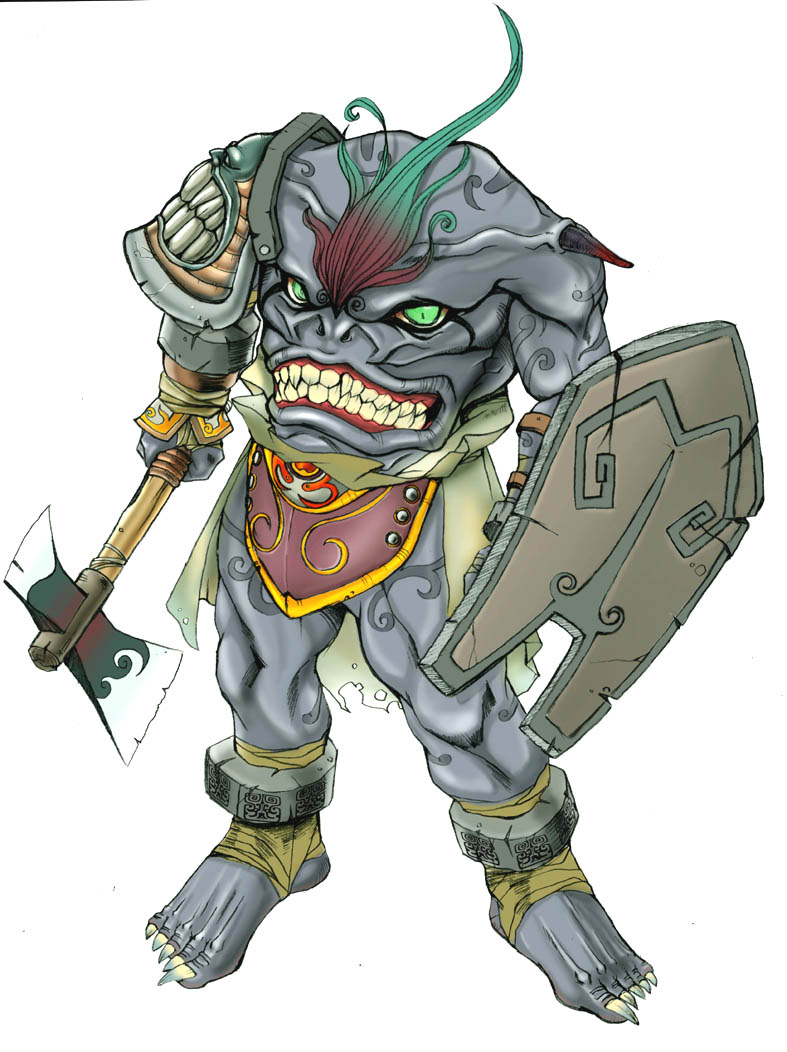
The Headless Giant (Xíngtiān 刑天)

Note: This post is the first in a series of 'blog swapping' posts I'll be doing with Scott, the author of the excellent Trollish Delver blog.
The Xíngtiān is a creature from the Chinese classic bestiary, the Shānhǎi Jīng. The latter is a very old book whose creatures do not feature prominently in Chinese fiction. This is why the Xíngtiān does not appear in The Celestial Empire. However, the Xíngtiān has recently undergone a surge in popularity in China because of its appearance in a number of on-line adventure games (see here and there). As a consequence, I have decided to make it available for Celestial Empire campaigns.

The Xíngtiān is a very ancient humanoid who predates even the most ancient Chinese chronicles. It is mentioned as an adversary in the battles fought by the Yellow Emperor in pre-dynastic times. It is told that the Xíngtiān challenged the Yellow Emperor for a duel; in the ensuing fight, the Yellow Emperor beheaded the giant humanoid. However, the blow did not kill the Xíngtiān; the monster fled without its head. From that time on, it used its nipples as eyes, and its navel as a mouth. According to the Shānhǎi Jīng, the Xíngtiān fights with an axe and a shield.

Characteristics:
STR 4D6+6 (20), CON 4D6 (14), SIZ 4D6+6 (20), INT 3D6 (10-11), POW 3D6 (10-11), DEX 3D6 (10-11), APP 1D6 (3-4).
Move: 10, Hit Points: 17, Damage Bonus: +1D6, Armour: 0.
Allegiance: Heterodoxy 5D4+5
Morale: Leader.
Skills: Climb 35%, Dodge 25%, Jump 30%, Knowledge (Region [Mountains]) 75%, Listen 25%, Science (Natural History) 20%, Spot 30%, Stealth 25%, Track 60%.
Spells: If the Xíngtiān has an INT greater than 12 it knows the following Battle Magic spells: Befuddle, Dispel, Heal, Mobility, Protection, with a skill value of 30%.
Attacks:
Giant axe 55%, damage: 2D8+2+db (bleeding)
Long Shield
Special defence:
Swallows weapon: whenever the Xíngtiān is hit in the Abdomen, it may swallow the weapon of its attacker on a successful STR vs STR roll on the Resistance table. Damage is still inflicted though.

Hit Location table
1D20 | Hit Location | Hit Point Value
1-5 | Right Leg | 1/3 total HP
6-10 | Left Leg | 1/3 total HP
11-13 | Abdomen | 2/5 total HP
14 | Chest | 1/2 total HP
15-17 | Right Arm | 1/4 total HP
18-20 | Left Arm | 1/4 total HP

Please go and check out Scott's T&T version of the Xíngtiān now. I'm amazed at how he's captured the monster's peculiarities using T&T's system.

2011-06-01

Armour and Heat

Looking at the map on page 28 of the rule book, all the provinces south of the North India-Lower Yángzi line have a humid subtropical climate. The omnipresent daytime heat and humidity affect the inhabitants' choice in armour: people in these areas avoid carrying any piece of armour whose Burden is Moderate (or heavier). Should a player character insist on carrying such a piece of armour, he must succeed at a Stamina roll every time he is doing any activity more tiring than walking. A failed roll results in the character losing 1 general hit point of damage because of fatigue. A fumble results in the character passing out with exertion (on top of the hp loss).