2012-08-20

Expanded Divination Skill

I have just bought Mythic Iceland by Pedro Ziviani. It is a Basic Role-Playing supplement designed to play in mediæval Iceland. Despite its title, Mythic Iceland is firmy set in real world history and is historically, linguistically, and culturally accurate. In that respect, it is similar to the Alephtar Games historical titles :)

Anyway, the nice thing about BRP games is that they are mutually compatible. And 'mutually compatible' means you can steal from a given game whatever you think is cool for your own.

The Celestial Empire features the skill of Divination (pages 59-62). Mythic Iceland similarly presents the skill of Prophecy (pages 206-208), which has a slightly different scope: instead of requiring to GM to come up with a cryptic sentence that somehow predicts future in-game events, it requires the player character using the Prophecy skill to try and give some input to the GM's game through the prophecy itself, i.e., it introduces player-driven narration. Also, the Mythic Iceland version of the skill is much more articulate, with scalable effects depending on the amount of power points spent by the player character.

This post adapts the ideas from Mythic Iceland to The Celestial Empire. By spending more than 1 Qì point, the player character may use the Divination skill as the Mythic Iceland Prophecy skill. Replace the following text from the Divination skill description on page 59 of TCE:
After spending 1 Qì point, the diviner performs a divination ritual according to the tenets of his religion, and consulting the appropriate source; then the GM rolls against the character's divination skill (the result of the roll must remain hidden from the player since he has no idea whether the attempts to prophesy the future was successful or not).
with:
After spending a variable amount of Qì points [see table], the diviner performs a divination ritual according to the tenets of his religion, and consulting the appropriate source; then the player rolls against the character's divination skill. Depending on the result, the player may or may not announce the prophecy.
Fumble > The player character has a prophetic vision of his own impending doom.
Failure > No prophecy.
Success > The player character has a prophetic vision of his future. The player may express it in a seven-word sentence.
Special > The player may express the prophecy in a nine-word sentence.
Critical > The GM cannot interfere with the prophecy.

The table referred to above is the following one:
The divination attempt only involves the diviner...........1 Qì point
The divination attempt involves another person...........2 Qì points
The divination attempt involves a group of people.........3 Qì points
A precise location is 'seen' in the prophecy.................+1 Qì points
Precise people are 'seen' in the prophecy....................+2 Qì points
The prophecy involves some misfortune......................cost×2
The prophecy involves death....................................cost×3


Example: a diviner attempts to prophesy what will happen to his brother who has set upon a dangerous endeavour in Bukhara with a band of fellow adventurers. The divination attempt involves a different person than the diviner: 2 Qì points. The divination attempt involves a precise person: +2 Qì point. The diviner would like the prophecy to involve death: cost×3. Total: a hefty 12 Qì points. The player successfully rolls against his skill and chooses the following prophecy: 'My brother kills the emir of Bukhara'. Now 12 Qì is a huge amount, but the GM may still think it's to easy to get away with it like that. That's where the GM may decide this will happen... several years in the future! maybe after the diviner's brother has escaped from a harrassing stay in the emir's penal labour camps...
2012-08-18

Seven Cryptical Books of Hsan

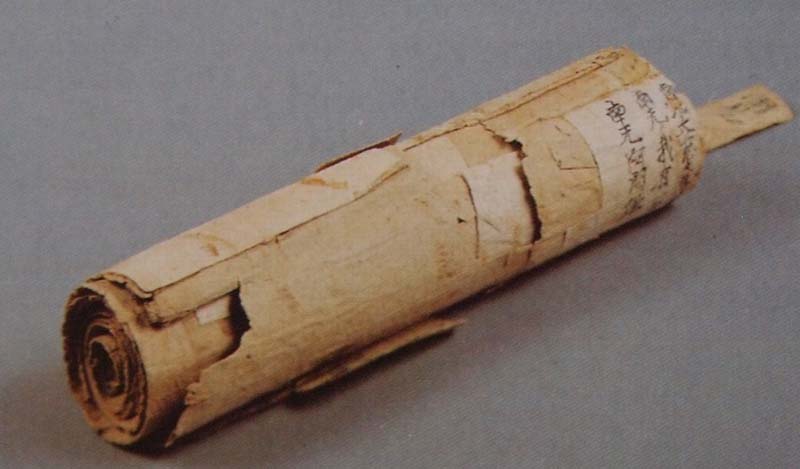
The Seven Cryptical Books of Hsan is a collection of fictional writings mentioned by Lovecraft in "The Other Gods" (1921) and "The Dream-Quest of Unknown Kadath" (1926). The books (or rather scrolls) are supposed to have been written in Classical Chinese around the 2nd century AD by the Chinese philosopher Hsan the Greater [although Hsan is not even a Chinese-sounding name]. The books allegedly contain information parallelling that contained in the Yìjīng, but with an esoteric rather than exoteric bent. Each scroll covers a specific subject:
  • Scroll One: the works of Huángdì, the Yellow Emperor, his miraculous inventions and cures.
  • Scroll Two: ritual cannibalism and ghoulish cults.
  • Scroll Three: spirits of the air.
  • Scroll Four: spirits of the water.
  • Scroll Five: Deep Ones off the south China coast and their human devotees; space and time: the hounds of Tindalos and the Liao drug.
  • Scroll Six: the Plateau of Leng in Central Asia and Unknown Kadath; their history and inhabitants.
  • Scroll Seven: a Mythos primer.
The Seven Cryptical Books of Hsan may thus be used much like the Yìjīng, but with a more sinister twist to its use. For instance using the Seven Cryptical Books of Hsan instead of the Yìjīng for a Divination skill roll (p59 of The Celestial Empire) may yield a darker bent to the results of the roll, or even ill-fated side effects. Using the example in the rule book, White Fox may want to follow the black falcon; however after having travelled through the mountains undetected by the guards in the fort, she may make more unsavoury an encounter, like a lone hermit dabbling in the black arts or even a Mythos-inspired creature...

Similarly, if the Seven Cryptical Books of Hsan are used instead of the Yìjīng for a Necromancy skill roll (p63 of TCE) the monster summoned or the answers received will certainly contain Mythos-inspired elements...

On top of their use as an alternative, sombrer version of the Yìjīng, the Seven Cryptical Books of Hsan contain useful information for player characters.
  • Scroll One will impart bonuses to characters using cure-like skills and/or spells.
  • Scroll Two contains information about Chinese ghouls (wǎngliáng). This kind of information enables Monster Hunters (see p54 of TCE) to create secret recipes to fight against wǎngliáng.
  • Scrolls Three and Four impart bonuses to the Conjure Elemental spell.
  • Scroll Five contains information about the Hǎiruò. This kind of information enables Monster Hunters (see p54 of TCE) to create secret recipes to fight the Hǎiruò.
  • Scroll Six gives +20% to Knowledge (Region [Central Asia]) and/or to Knowledge (Region [Tibet]) in any cross-over CoC/TCE campaign game.
  • Scroll Seven gives +20% to Knowledge (Religion [Cthulhu Mythos]) in any cross-over CoC/TCE campaign game.

Perusing these scrolls may increase the Cthulhu Mythos Allegiance score of the reader (if used) or, alternatively, reduce the Buddhism allegiance score/increase the Heterodoxy allegiance score by 1 for each scroll read.

2012-07-03

Brocade Guards (Jǐnyī Wèi 錦衣衛)

I haven't posted for a long time because I'm pretty busy these days. I tend to try and favour personal research for my Celestial Empire posts, so I'd rather keep quiet for a while than post uninteresting stuff.

However I really feel I have to post something now. Posting about the Brocade Guards (Jǐnyī Wèi 錦衣衛) of the Míng emperors has been on my to-do list for quite some time now. Unfortunately I really haven't been able to do any personal research, so the following is mostly a summary from the Wikipedia.

The Jǐnyī Wèi (錦衣衛; literally "Brocade-Clad Guard") was the imperial military secret police of the Chinese emperors of the Míng Dynasty and were bound to serving the emperor only, and to taking orders from him only. The Jǐnyī Wèi was founded by the Hóngwǔ Emperor in 1368 to serve as his personal bodyguards and it developed into a military organisation the following year. They were authorised to overrule judicial proceedings in prosecutions, with full autonomy granted in arresting, interrogating and punishing anyone, including nobles and the emperor's relatives.

The Jǐnyī Wèi were also tasked with collecting military intelligence on the enemy and participated in battle planning stages. A Brocade Guard donned a distinctive golden-yellow uniform, with a tablet (pictured) worn on his torso, and carried a special blade weapon.

In 1393, the Hóngwǔ Emperor curtailed the Brocade Guards' powers after they allegedly abused their authority during the investigation of a rebellion plot, in which about 40,000 people were implicated and executed. When the Yǒnglè Emperor ascended to the throne, he was afraid that his subjects might be discontented with him, because he came to power by usurping his nephew's throne. He reinstated the Brocade Guards' authority to increase his control over the imperial court.

In the later years of the Míng Dynasty, the Brocade Guards were placed under the control of the eunuch faction. As the government sank into corruption, the Jǐnyī Wèi was constantly used as a means of eliminating political opponents through assassinations and legal prosecution.

The Jǐnyī Wèi was eventually disbanded by the Qīng in 1644.


The Jǐnyī Wèi feature prominently in fiction set in the Míng. The 2010 film 14 Blades focuses on the adventures of a group of ninja-like Brocade Guards.

Scenario seed: Both a judge and his retainers, and a grup of brocade guards are after a corrupt official. The former want to arrest and publicly try him, the latter simply want to eliminate him. The PCs are in either group and must fight both the corrupt official's bodyguards and the other party.
Alternatively, two groups of PCs could compete with each other (this would need two GMs).

2012-06-17

Fortune Cookies

Let's make one thing clear: there aren't any fortune cookies in China. There've never been any, there'll never be any.

Fortune cookies were invented at the beginning of the 20th century by Chinese immigrants to the United States to be served as dessert in Chinese restaurants in the United States. Restaurants do not serve dessert in China; it is a very Western thing to finish one's meal with dessert.

So please no fortune cookies in Celestial Empire games.

2012-06-16

Saṃsāra (cont'd)

I have already posted about Saṃsāra, the Buddhist cycle of birth, life, death, and rebirth. As explained in that post, it is every living being's lot to live, die, and be re-born in one of the "six destinies": deity, human, asura, animal, hungry ghost, or hell-dweller.
My post also featured quite a simple picture of this wheel of reincarnation.

Now I have found another picture of the wheel of saṃsāra, on a Buddhist blog that I follow, which in my opinion explains it even better:


The black arrows indicate the various possibilities of birth, life, death, and rebirth. It is apparent from the picture above that life in any one of the six destinies can lead to rebirth in any one of the six destinies, depending on one's behaviour vis-à-vis the five precepts and the ten good deeds (going "up") and the ten evil deeds and the five heinous crimes (going "down").

An interesting feature of the picture above, compared with the one in my earlier post, is that it also shows that nirvāna, i.e., liberation from the wheel of reincarnations, is possible -- it is actually the aim of Buddhism.

Now an even more interesting thing about the picture above is that it clearly shows that although the abode of deities (labelled Brahmaloka and Devaloka here) is "higher" than the world of men,  nirvāna may only be achieved from the latter.