2012-01-27

Chinese Number Gestures

Because of the many dialectal differences in China, the Chinese have developed a method of using one's hands to signify the numbers 1 to 10.

Numbers 1 to 5 are, like in the West, simply signified through the number of fingers shown. Note, however, the slight differences with Western usage, most due to the Chinese not using the thumb, except for the number "5".

Numbers 6 to 10, contrary to Western usage, are signified by mimicking the relevant Chinese character using the position of the fingers as if they were character strokes (see picture).

In role-playing situations these number gestures can be used if the PCs have to communicate discreetly (e.g., during business negotiations), or if they are in a place where speaking is impossible (e.g., they are ambushing an adverse party and they need to communicate the number of people in the party), etc.

Obviously these number gestures could also be used to express larger numbers (seven could also mean seventy if the context is unambiguous; a "3" closely followed by an "8" could mean 38; etc.).

2012-01-26

Design Your Character

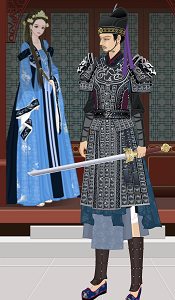
There's this nifty web-site for creating costumed dolls on-line... and one of the sub-categories is Korean Warrior! Obviously you can use it to design your Celestial Empire character.

The Korean apparel is supposedly from late Silla [Xīnluó  新羅], which almost exactly corresponds to Táng in China. But I believe this kind of clothing would fit TCE characters up until the Sòng.

I created the warrior above in two-three minutes of time. The scenery is fixed.

2012-01-24

Asian Barbaric Tribe Generator

This is another post inspired by Secret Santicore 2011! This time I am Sinicising Zak Sabbath's Barbaric Tribe Generator.

Roll 6D10 and 2D8, and pray Guānyīn for mercy!

㊀ TABLE I: The cruel and barbarous ways that they adorn themselves

  1. With dogs. Each is chained to a dog (see p335 of BRP)
  2. With a strange bluish paint that renders them fanatical (see p75 of TCE) for ten minutes
  3. With the skins of their forebears. Each tribesman must grow all fat in his dotage so that his son may wear a suit made from his skin and hide inside it. Nobody knows what they look like
  4. With barbarous tattooings. Actually they're pretty bright — each tribesman keeps all his important information tattooed somewhere. Notes on habits of local fauna, phases of the moon, maps, last time the neighbouring trading post was looted, and so on
  5. With the garish and mismatching patterns of many animals. The effect is equivalent to Befuddling the onlookers (see p75 of TCE)
  6. With elaborate tattoos made of Chinese characters. Any literate onlooker will try and read the tattoos instead of fighting the tribesman
  7. With dung. They a-smear themselves and this attracts bugs that act as an insect swarm (see p336 of BRP) against enemies
  8. With the bones and teeth of their fallen (human) foes. New and untested tribesmen have like no clothes upon them because they never killed anyone and the old warmaster crusties have like bonetooth armour (4AP)
  9. With poison (POT 10+1D4). Overcome the poison's potency or take damage equal to it
  10. With two cartridge belts

㊁ TABLE II: Their savage and ignorant beliefs

  1. They don't believe in killing animals because they're innocent. Got no problem killing people though
  2. They believe the soul is contained in the right foot and will evince an unhealthy obsession with severing a foe's right foot, to the exclusion of all other hit locations. Subtract 10 from all their mêlée hit location rolls
  3. They hate food and the eating of food. Publicly. In secret they all eat food (of course) and like it but in company they pretend they don't
  4. They don't believe in Confucianist virtue, Buddhist non-violence, Daoist wúwéi, etc.; they believe in quite the opposite, actually
  5. They believe that emissaries of foreign religions are an abomination and will concentrate all their energy on destroying any priestly player characters
  6. They believe it is blasphemous to use anything that is not stolen. Their equipment, homes, mounts and mates are all stolen
  7. They believe that if they are seen by anyone older than them they'll be owned by them in the afterlife
  8. They believe the first attack must always be a bite. They sharpen their teeth
  9. They believe that collecting their foes' severed heads will advance them spiritually. Add 10 to all their mêlée hit location rolls
  10. They believe that they are the only humans beings in the world and that all other people are demons in disguise

㊂ TABLE III: Details on the tribe's leader

  1. He is hideous and clothed in shadow
  2. He has worms in his head
  3. He has a hump like a camel, filled with jewels
  4. He owes a PC a single favour
  5. His fingernails are nine cùn long (see p20 of TCE)
  6. He is a Nāga (see p125 of TCE)
  7. He is a Yaksha (see p126 of TCE)
  8. He hopes to wage war against the moon and betroth Cháng'é
  9. He's always intoxicated
  10. He is, secretly, at the centre of all events in the campaign


㊃ TABLE IV: Their vicious bestial totems

  1. Their totem is the locust. They gibber and swarm
  2. Their totem is the maggot. They revel in ignorance
  3. Their totem is the jackal. They belong to treachery
  4. Their totem is the crocodile. They are patient, they are swift
  5. Their totem is the hog. They wallow and they wail
  6. Their totem is the scorpion. They live in solitude
  7. Their totem is the centipede. They form a long lean line
  8. Their totem is the snow leopard. They move in darkness
  9. Their totem is the wolf. They harry and howl
  10. Their totem is the suānní. They will burn you

㊄ TABLE V: The tribe's most sacred and vile object of reverence

  1. A powder with unusual properties
  2. Yak butter. A mound of it
  3. Your tears and those of many foes. In a great urn
  4. A baby wǎngliǎng (see p115 of TCE)
  5. The clothes once worn by a corrupt xiān
  6. A trident
  7. The defaced stone ball of a shīzi (see p126 of TCE)
  8. A Tarim mummy
  9. A fat, four-footed weasel carved of lard, smothered in beets
  10. Severed fingers, kept in the finest silk

㊅ TABLE VI: The twisted shamans that guide them

  1. Atavistic, armed with acid, aided by asps
  2. Belligerent, bony, bedecked with baubles. Breathes bats
  3. A crazed and crooked crone. Covered in clusters of candles
  4. A devious dervish. Dominates demons with a dazzling dance
  5. An eight-eyed exotic. An eater of eldritch energies. Engages in echolocation
  6. A fat faction of fleshy flagellants
  7. A glossy guǐ-gadfly. Guarded by ghosts
  8. A hebephrenic harlot. Housed in a hexagon
  9. An idiot and an incunabulist
  10. A jovial juvenile in a jewelled jerkin


㊆ TABLE VII: The tribe's name

Roll 2D8 (for first and second syllable of tribe's name):

  1. Bái-
  2. Běi-
  3. Cháng-
  4. Chì-
  5. Dōng-
  6. Luǒ-
  7. Nán-
  8. Xī-

  1. -dí
  2. -fán
  3. -hú
  4. -lǔ
  5. -mán
  6. -qiāng
  7. -róng
  8. -yí

2012-01-23

The Miáo (苗)

Amongst the various tribes of south-central China, the Miáo (or Hmong) have always been one of the most troublesome for central government. As such they are very present in Chinese myths and legends, much more so than other mountain peoples. There are countless accounts of Miáo rebellions, followed by harsh repression campaigns by the various Chinese dynasties, the worse being the devastating massacres organised by the Qīng in the second half of the 19th century. No wonder that, in time, the Miáo have slowly moved southwards from their ancestral home in south-central China to South-East Asia.

The following is a very evocative excerpt from the book Hmong and American: stories of transition to a strange land by Sue Murphy Mote (2004).

The Hmong were furious fighters. Since Shāng times their abilities had been sharpened by the need to defend what they desperately considered theirs. Guìzhōu Hmong, those against whom the Míng built the ten-foot high Hmong Wall, dressed themselves in armour made of buffalo hide, copper, and iron mail. They carried a shield in one hand, a spear in the other, and a knife in the teeth. Crossbows and poisoned arrows rounded out the arsenal. In the late 1600s, a Chinese factional general multiplied the power of the Hmong juggernaut immeasurably when he left behind in a Hmong village some flintlock rifles, gunpowder, and cannons. Another Chinese general, whom the Hmong had sheltered, showed the Hmong how to manufacture their own flintlocks, or blunderbusses, an item used in colonial America around the same time. Hmong made them by the thousands.
At the same time, Hmong began breeding mountain ponies for war. These animals, able to race up and down mountainsides, were regarded by the Chinese as the best horses in the empire.

The "Hmong Wall" mentioned above was like a miniature version of the Great Wall, one hundred-mile long, ten-foor high, and with watchtowers manned by armed guards that the Míng had built in the 16th century. This wall was to contain the Miáo within a given territory, where the Míng troops would foray to capture boys to be mass castrated and turned into eunuch slaves. This territory had the worse lands whereas the best arable lands were given to Hàn colonists. Some of the colonists (mostly Hàn soldiers who crushed the rebellion) would also be given Miáo wives.

2012-01-22

春節快樂!

Happy new year! The year of the Metal Rabbit is ending today, and the year of the Water Dragon starts tomorrow!

The Chinese New Year is the occasion for all Chinese to tidy up their homes, throw out old objects, buy new shoes and new clothes, and, most importantly, to remove the worn-out pictures of the Door Gods and to replace them with brand new shiny ones. See also p13 of The Celestial Empire.

The two pictures of the Door Gods (ménshén 門神) are placed on each side of the main entrance to the Chinese home and stand guard there for a full year to keep away evil spirits. The pictures face each other — it is considered bad luck to place them back-to-back.

Scenario Seed: Save the New Year!
The characters are resting in the city of [city name] before the Spring Festival. They are in the city magistrate's employ, or owe him a favour. They are summoned to the city yámén in the night before New Year's Day by a close retainer of the city magistrate. This is very unusual, since even civil servants are supposed to be off duty and celebrating with their family on New Year.
The magistrate receives them in casual dress... this is even more intriguing. He explains them that the situation is so urgent that he forgot about behaving properly. May Confucius forgive his misbehaviour. The whole stock of Door Gods prints that the city printer had prepared for distribution the next day has been stolen! The characters must absolutely find a solution or the whole city will go in panic mode once the disappearance of the good luck-bringing posters becomes public!

The characters may suggest...
  • that the printer re-print a batch of Door Gods pictures. This is impossible because there's not enough paper left.
  • that the magistrate buy a batch of pictures from another printer. This is impossible because the closest is in the next city, which is one day travel from their city.

Possible courses of action: the PCs could try and find paper somewhere (didn't that Buddhist abbot want to print out the Dàzàngjīng?), or they could try and a find a means to travel faster (isn't there a Daoist hermit in the mountains who can travel 500 lǐ in a day?). The best idea, however, would be retracing the thief. He's currently on the river bank, waiting for a boat that will take him to a city downstream where he's planning to sell the images.

Possible consequences should the PCs fail: Panic spreads through the city. Ne'er-do-wells and thieves take advantage of it to commit burglaries. The following days, having had word of the situation, brigands raid the city. In a campaign game with supernatural elements, the city could even fall prey to demons or yāoguài.